Big 4 Real Estate Firm Selector & Comparison Tool
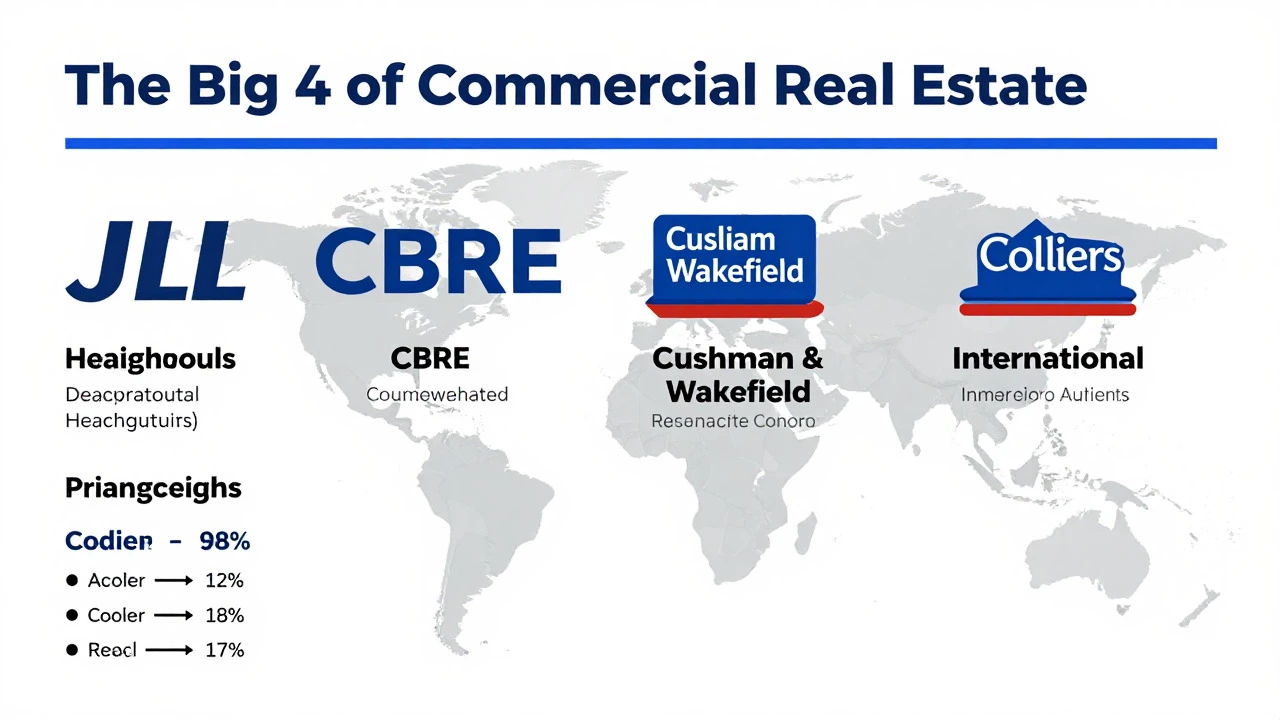
Use this tool to compare the Big 4 commercial real estate firms (JLL, CBRE, Cushman & Wakefield, Colliers) based on your specific needs and asset type.
When you look at a skyscraper or a sprawling shopping center, you might wonder who actually runs the numbers behind those massive deals. In the world of commercial property sale is the process of buying and selling income-generating real estate assets such as offices, retail spaces, and industrial warehouses., four names dominate the conversation. They are known collectively as the "Big 4" of commercial real estate services.
You’ve probably heard the term "Big 4" before, but it usually refers to accounting firms like Deloitte or PwC. In our industry, the landscape is different. The Big 4 here are the global giants that handle leasing, sales, valuation, and investment management for the biggest portfolios on the planet. Knowing who they are matters because if you are looking to sell a significant commercial asset, these firms often hold the keys to finding qualified buyers.
The Four Giants: Who Makes the Cut?
The title of "Big 4" isn't officially regulated by any government body, but it is widely accepted by industry analysts based on revenue, market share, and global footprint. These firms have been around for decades, surviving recessions and market crashes to become the standard-bearers of the industry.
- JLL (Jones Lang LaSalle) is a leading professional services and investment management firm specializing in real estate, founded in 1798 and headquartered in Chicago.
- CBRE Group is the world's largest commercial real estate services and investment firm, formed by the merger of Coldwell Banker Commercial and Real Estate Group in 1995.
- Cushman & Wakefield is a global commercial real estate services firm founded in 1917, known for its strong presence in office leasing and investment sales.
- Colliers International is a Canadian-headquartered global real estate services company that operates through an independent franchise model, focusing heavily on tenant representation and capital markets.
These aren't just local agencies with big signs. They operate in over 100 countries. When a multinational corporation needs to lease 50,000 square feet of office space in Sydney, London, and New York simultaneously, they call one of these four. Their networks allow them to move capital and tenants across borders with ease.
Why Market Share Matters in Commercial Sales
If you are holding a commercial property for sale, your choice of agent can dictate your timeline and final price. The Big 4 dominate because they control the flow of information. In commercial real estate, data is currency. These firms spend millions annually on proprietary research platforms that track vacancy rates, rental yields, and transaction volumes.
| Firm | Headquarters | Primary Strength | Global Reach |
|---|---|---|---|
| JLL | Chicago, USA | Investment Management & Advisory | 80+ Countries |
| CBRE | Dallas, USA | Scale & Transaction Volume | 100+ Countries |
| Cushman & Wakefield | Dublin, Ireland | Office Leasing & Valuation | 70+ Countries |
| Colliers | Toronto, Canada | Tenant Representation & Flexibility | 70+ Countries |
For example, CBRE often leads in total transaction value simply due to its sheer size. If you have a unique, high-value asset-like a specialized logistics warehouse or a Class A office tower in a prime CBD location-their buyer database is likely the most extensive. However, size isn't everything. Sometimes, a smaller boutique firm can offer more personalized attention. But when it comes to liquidity and speed, the Big 4 usually win.
Services Beyond Selling: What Else Do They Do?
It’s easy to think of these companies only as brokers who list properties. That’s only part of the picture. Their business models are diversified into several key pillars:
- Property Management: Day-to-day operations, maintenance, and tenant relations for large portfolios.
- Valuation & Advisory: Providing unbiased appraisals for banks, investors, and tax authorities.
- Project & Development Consulting: Helping developers figure out what to build before a single shovel hits the ground.
- Capital Markets: Facilitating loans, refinancing, and securitization of real estate assets.
This full-service approach creates a sticky relationship. A client might start with a valuation, then hire the same firm for property management, and eventually use them for the sale. This vertical integration means the Big 4 have deep insights into how buildings perform, which gives them an edge when marketing a sale. They can show potential buyers not just photos, but detailed financial projections backed by their own research data.
The Australian Context: Local Presence vs. Global Power
Living in Adelaide, I see how these global players adapt to local markets. While they are American or Canadian-founded, their Australian branches are often led by local experts who understand the nuances of state-based planning laws and regional economic drivers.
In Australia, the competition is fierce. You also have strong domestic players like Savills, Knight Frank, and Lister Hooper. However, the Big 4 still command the top tier of institutional transactions. If you are selling a small retail strip mall in the suburbs, a local agency might be sufficient. But if you are disposing of a multi-story office block in Melbourne or Sydney, the institutional buyers-superannuation funds, foreign sovereign wealth funds, and private equity firms-typically work exclusively with the Big 4 or similarly sized international brands.
Why? Because trust and compliance. Institutional buyers require rigorous due diligence. The Big 4 have standardized processes and legal frameworks that meet international standards. This reduces friction in cross-border deals. For instance, a Japanese investor buying an Australian hotel wants to know that the valuation methodology used by Cushman & Wakefield in Tokyo is consistent with their report in Brisbane.
Choosing the Right Partner for Your Sale
So, should you always go with one of the Big 4? Not necessarily. It depends on your specific goals and the nature of your asset.
Consider these factors before signing an exclusive listing agreement:
- Asset Complexity: Is your property standard or niche? Standard assets benefit from the Big 4's broad reach. Niche assets might need a specialist broker who knows every player in that specific sub-sector.
- Fee Structure: Big firms often charge higher base fees, but they may negotiate lower success fees for very large transactions. Always ask for a breakdown of costs.
- Team Dynamics: You don’t hire the brand; you hire the person. A senior director at a Big 4 firm might give you less time than a partner at a mid-sized firm. Interview the actual team that will handle your file.
- Marketing Budget: Ask how much they will invest in marketing your property. The Big 4 typically have larger budgets for digital campaigns, video production, and international outreach.
I’ve seen sellers make the mistake of assuming that handing keys to a big name guarantees a quick sale. Without active engagement from the owner and a tailored strategy, even the best brand can stall. Make sure you align on expectations early. Demand regular updates, clear communication channels, and a defined marketing plan.
The Future of the Big 4: Tech and Sustainability
The industry is changing fast. Technology and environmental regulations are reshaping how these giants operate. All four firms are investing heavily in PropTech (property technology). Think AI-driven pricing models, virtual reality tours, and blockchain for secure transactions.
Sustainability is another major shift. Buyers increasingly demand green-certified buildings. The Big 4 are leading the charge in ESG (Environmental, Social, and Governance) consulting. They help landlords retrofit buildings to reduce carbon footprints, which in turn increases asset value. If you are selling a commercial property today, its energy efficiency rating could be just as important as its location. The Big 4 have dedicated sustainability teams to assess and improve this metric, adding tangible value to your sale.
As we move further into 2026, the gap between traditional brokerage and tech-enabled advisory is closing. The firms that thrive will be those that combine human expertise with data intelligence. The Big 4 are well-positioned for this transition due to their resources, but agility remains a challenge for such large organizations.
Final Thoughts on Navigating the Market
Understanding the Big 4 in real estate gives you leverage. Whether you choose to work with them or a competitor, knowing their strengths helps you ask better questions. You’ll know what to expect in terms of reporting, marketing, and buyer access.
Don’t let the brand name intimidate you. Treat them as service providers accountable to your goals. Compare proposals, check references, and ensure cultural fit. In commercial property sale, the right partnership can mean the difference between a fair market price and leaving money on the table.
Remember, the market is cyclical. Timing your exit strategically, combined with the right advisor, maximizes your return. Keep an eye on interest rate trends and local supply pipelines. The Big 4 publish monthly reports that can guide your timing decisions. Use their data to your advantage, regardless of who you hire.
Who are the Big 4 in commercial real estate?
The Big 4 in commercial real estate are JLL, CBRE, Cushman & Wakefield, and Colliers International. These firms are recognized globally for their dominance in transaction volume, market share, and comprehensive service offerings including sales, leasing, valuation, and property management.
Is CBRE bigger than JLL?
Yes, CBRE is generally considered the largest commercial real estate services firm in the world by revenue and transaction value. However, JLL often competes closely in specific segments like investment management and advisory services. Rankings can fluctuate slightly year by year based on market conditions.
Should I use a Big 4 firm to sell my small commercial property?
Not necessarily. For smaller assets, local boutique agencies may offer more personalized service and competitive fee structures. The Big 4 excel with large, complex, or institutional-grade assets where their global network and data resources provide a distinct advantage. Evaluate your asset size and target buyer pool before deciding.
How do the Big 4 differ from residential real estate agents?
Commercial real estate focuses on income potential, lease structures, and investment returns rather than emotional appeal. Agents specialize in asset classes like office, retail, industrial, or hospitality. Transactions involve longer timelines, complex contracts, and institutional buyers. Residential agents primarily deal with homes and individual buyers.
Do the Big 4 operate in Australia?
Yes, all four firms have significant operations in Australia. They maintain offices in major cities like Sydney, Melbourne, Brisbane, Perth, and Adelaide. They compete alongside strong local and international rivals like Savills and Knight Frank, particularly in institutional transactions and high-value sales.