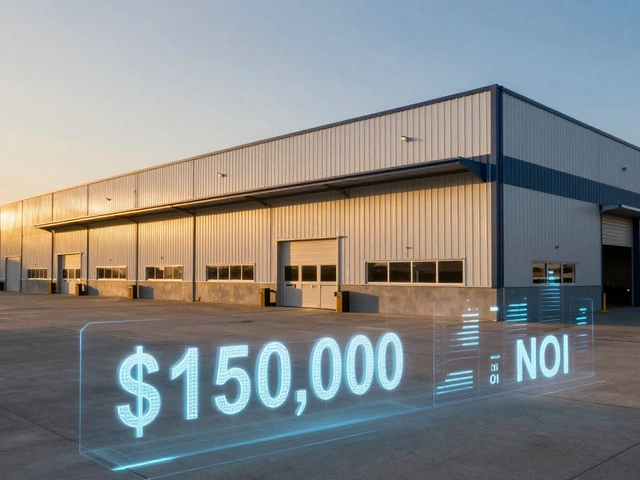
Commercial Equity Extraction Calculator
Quick Takeaways: Your Equity Options
- Cash-Out Refinance: Replace your current loan with a larger one and take the difference in cash.
- Equity Line of Credit: A flexible revolving credit line based on the property's value.
- Partial Sale: Sell a piece of the land or a specific unit to unlock capital.
- Sale-Leaseback: Sell the property to an investor and lease it back to keep operating there.
- Cross-Collateralization: Use the commercial equity to secure a loan for another project.
The Classic Cash-Out Refinance
The most common way to pull money out is through a Cash-Out Refinance. This is where you take a new mortgage on your property for a higher amount than what you currently owe. The lender pays off your old loan and hands you the remaining balance in cash.
For example, say you bought an office block for $1 million years ago and now owe $400,000. If the property is now worth $2 million, and the bank allows a 70% Loan-to-Value Ratio (LTV), they'll lend you $1.4 million. After paying off your $400,000 debt, you walk away with $1 million in your pocket.
But here is the catch: you're increasing your monthly debt. If interest rates spike or a major tenant leaves, that larger loan can become a noose. You need to make sure your commercial property equity is extracted sustainably so you don't risk foreclosure during a market dip.
Using an Equity Line of Credit (ELOC)
If you don't need a massive lump sum right now but want a safety net for future growth, a Equity Line of Credit (or a commercial HELOC) is a better bet. It works like a credit card backed by your real estate.
Instead of taking $500,000 all at once and paying interest on it immediately, you're approved for a limit. You draw from it only when you need to-perhaps for a renovation to increase rent or to snag another undervalued property. This keeps your interest costs lower because you only pay for what you actually use.
| Feature | Cash-Out Refinance | Equity Line of Credit |
|---|---|---|
| Payout Method | Lump Sum | Revolving/Flexible |
| Interest Cost | On full loan amount | Only on drawn funds |
| Best For... | Major investments/Debt payoff | Operating capital/Gradual growth |
| Risk Level | Higher monthly fixed cost | Variable rate risk |
The Strategic Sale-Leaseback
Sometimes, the best way to get equity out isn't through a bank, but through a Sale-Leaseback. This is a power move often used by larger companies. You sell the property to a real estate investor at full market value and simultaneously sign a long-term lease to stay in the building as a tenant.
Why would you do this? It converts a non-liquid asset (the building) into liquid capital (cash) without disrupting your business operations. If you own a medical clinic and the building is worth $3 million, but you only need the clinic to treat patients, selling the shell and leasing it back lets you put that $3 million into expanding your practice or investing in new equipment.
The trade-off is that you no longer benefit from future property appreciation, and you now have a monthly rent expense. It's a move for those who prioritize business growth over real estate ownership.

Partial Divestment and Subdividing
If you have a large parcel of land or a multi-unit complex, you might not need to mortgage the whole thing. Partial Divestment involves selling off a portion of the asset.
Imagine you own a large industrial site with an extra two acres of unused land on the side. Instead of borrowing against the whole site, you subdivide that land and sell it to a developer. You get a cash injection without adding a single cent of debt to your balance sheet. This is the cleanest way to unlock equity because it reduces your risk rather than increasing it.
Cross-Collateralization for Portfolio Growth
For those looking to scale, Cross-Collateralization is a useful tool. Instead of taking cash out to spend, you use the equity in your current commercial property as a guarantee for a loan on a new property.
Banks love this because it gives them more security. You can often secure a much lower deposit (or even a 100% loan) on a second property by pledging the equity of the first. This allows you to grow your portfolio exponentially without needing to save up massive cash deposits for every new purchase.
Common Pitfalls to Avoid
Extracting equity can feel like free money, but it's actually shifting risk. One major mistake is over-leveraging. If you pull out too much cash and your LTV climbs toward 80%, you're in the "danger zone." A small drop in market values could leave you with negative equity, meaning you owe the bank more than the building is worth.
Another trap is ignoring the tax implications. While a loan isn't taxable income, the way you use that money might be. If you use the equity to buy another income-producing asset, the interest on that loan is generally tax-deductible. However, if you pull equity out to buy a personal boat or a luxury car, that interest is usually not deductible. Always check with a CPA before making a move.
What is a good LTV ratio for commercial equity extraction?
Most commercial lenders prefer an LTV (Loan-to-Value) ratio between 65% and 75%. If you try to push for 80% or higher, you'll likely face much higher interest rates or stricter requirements regarding the lease terms of your tenants.
How does the bank determine how much equity I can take out?
Banks use two main metrics: the current appraised market value of the property and the DSCR (Debt Service Coverage Ratio). The DSCR measures the property's net operating income against the total debt payments. If the rent doesn't comfortably cover the new, larger loan, the bank will limit how much equity you can extract regardless of the property's value.
Is it better to refinance or get a new loan?
Refinancing is usually better if your current interest rate is higher than today's market rates or if you want to consolidate debt. If you have a fantastic low rate on your existing mortgage, it's often smarter to take out a second "mezzanine" loan or an ELOC so you don't lose the cheap money on your primary mortgage.
Can I get equity out if my property is vacant?
It's significantly harder. Lenders rely on cash flow to secure commercial loans. If the building is empty, you'll likely need to provide a personal guarantee or show significant liquid assets (cash reserves) to prove you can pay the mortgage until a tenant is found.
How long does the equity extraction process take?
Expect a timeline of 30 to 90 days. Commercial loans require detailed appraisals, a thorough review of lease agreements, and an analysis of the local market. It's much slower than a residential loan because the due diligence is far more intense.
Next Steps for Property Owners
If you're ready to move forward, your first step shouldn't be calling a bank-it should be getting a fresh, independent appraisal. You need to know exactly what the market thinks your building is worth today, not what you think it is. Once you have that number, calculate your current LTV.
If you're an aggressive grower, look into cross-collateralization to snap up new assets quickly. If you're risk-averse, consider a partial sale or a small ELOC. No matter the path, keep a close eye on your vacancy rates; a single empty suite can be the difference between a successful equity pull and a stressful loan default.