Apartment Occupancy Calculator
Calculate Your Apartment's Realistic Capacity
Determine how many people can comfortably live in your 1000 sq ft 2BHK apartment based on Australian housing standards and comfort guidelines.
Space Overview
A 1000 sq ft 2BHK has approximately 150-200 sq ft of open space for movement, furniture, and daily life after accounting for rooms.
- Minimum space per person (comfortable) 150-200 sq ft
- Available open space 150-200 sq ft
- Legal occupancy limit (SA) 4 people
Enter your details and click Calculate to see your results.
A 1000 square-foot apartment isn’t huge, but it’s also not tiny. In cities like Adelaide, Sydney, or Melbourne, this size is one of the most common layouts for a 2BHK - two bedrooms, a hallway, a kitchen, a bathroom, and a living area. So how many people can actually live comfortably in it? The answer isn’t just about math. It’s about sleep, storage, movement, and sanity.
What Does 1000 Square Feet Actually Look Like?
Let’s start with the basics. A 1000 sq ft apartment is roughly the size of a standard two-car garage laid flat. That’s enough space to fit a full-size bed in each bedroom, a sofa, a dining table, and a kitchen with a fridge and stove. But if you’ve ever tried to fit four adults into that space for a weekend, you know it gets tight fast.
Typical breakdown for a 1000 sq ft 2BHK in Australia:
- Master bedroom: 100-120 sq ft
- Second bedroom: 80-100 sq ft
- Living area: 250-300 sq ft
- Kitchen: 80-100 sq ft
- Bathroom: 50-60 sq ft
- Storage/hallway: 50-70 sq ft
That leaves about 150-200 sq ft of open space for movement, furniture, and daily life. Not a lot when you’re trying to cook, work from home, and have guests over.
How Many People Can Live Here? The Numbers
The short answer: two adults can live comfortably. Three people can work - if they’re flexible. Four is possible, but only under specific conditions.
Here’s how it breaks down:
- One person: Plenty of room. You’ll have space for a home office, extra storage, and even a small workout area.
- Two adults: Ideal. Each gets their own bedroom. The living area doubles as a shared space for meals, TV, and relaxing. No one’s stepping over each other.
- Three people: Doable. This usually means two adults and one child (or one adult and two teens). The third person sleeps in the second bedroom. If it’s a teenager, they might need a desk or storage space - which means the room needs to be used as both bedroom and study. It works, but it’s tight.
- Four people: Only if two are young children. Two adults, two kids under 10? Possible. Kids share a room. Parents use the living area as a secondary sleeping zone with a fold-out couch. But if one of those kids is over 12? You’re looking at daily friction. No privacy. No quiet space. No room for a home office or hobbies.
Australia’s building code doesn’t set a legal limit on how many people can live in a 1000 sq ft unit - but local councils often enforce occupancy rules based on plumbing, fire safety, and habitability standards. In Adelaide, for example, a 2BHK apartment is typically approved for a maximum of four occupants, assuming no one has a disability requiring extra space.
What Happens When You Overcrowd?
People do it. Not because they want to, but because rent is high. A 1000 sq ft apartment in Adelaide’s inner suburbs might rent for $550-$650 a week. Split four ways? That’s $137 per person. A 400 sq ft studio? $400/week - $100 each. The math pushes people into overcrowding.
But here’s what happens when you squeeze too many people in:
- No personal space: If someone needs to work from home, they’re either on the couch or in the bathroom with a laptop.
- Storage becomes a nightmare: Clothes, shoes, books, gear - everything piles up. No closets? You’re using suitcases as storage.
- Shared bathroom stress: One bathroom for four people means morning queues. One person’s shower delays everyone else’s.
- Conflict increases: A 2023 study from the University of South Australia found that households in apartments under 1100 sq ft with more than three occupants reported 47% higher stress levels over noise, privacy, and cleanliness.
It’s not just uncomfortable - it’s unhealthy.
Real-Life Examples
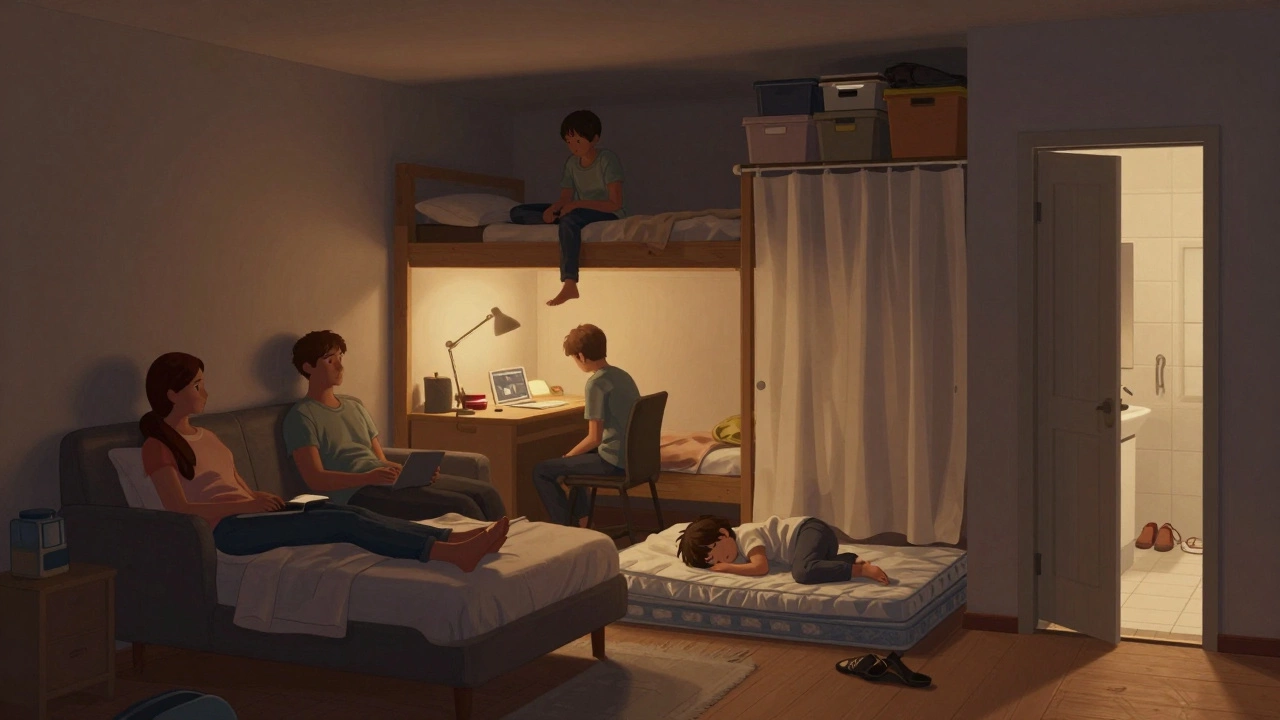
Take the Smith family in Norwood. Two adults, two kids - 8 and 11. They live in a 1000 sq ft 2BHK. The older kid sleeps in the second bedroom. The younger one sleeps on a bunk bed in the living room, tucked behind a curtain. They use a fold-out desk in the kitchen for homework. It works - barely.
Then there’s Liam and Zoe, both remote workers, sharing a 1000 sq ft unit in Glenelg. They have a guest bed that pulls out. When Liam’s parents visit for two weeks? They sleep on the couch. No one’s mad. But it’s not sustainable. After that trip, they started looking for a bigger place.
And then there’s the group of four university students who pooled their rent to live in a 2BHK in Prospect. Two bedrooms, four people. They rotate who sleeps on the couch. One person’s always sleeping on the floor. They’ve had three arguments about laundry in six months.
These aren’t outliers. They’re common.
How to Make It Work - If You Have To
If you’re stuck in a 1000 sq ft apartment with more than two people, here’s what helps:
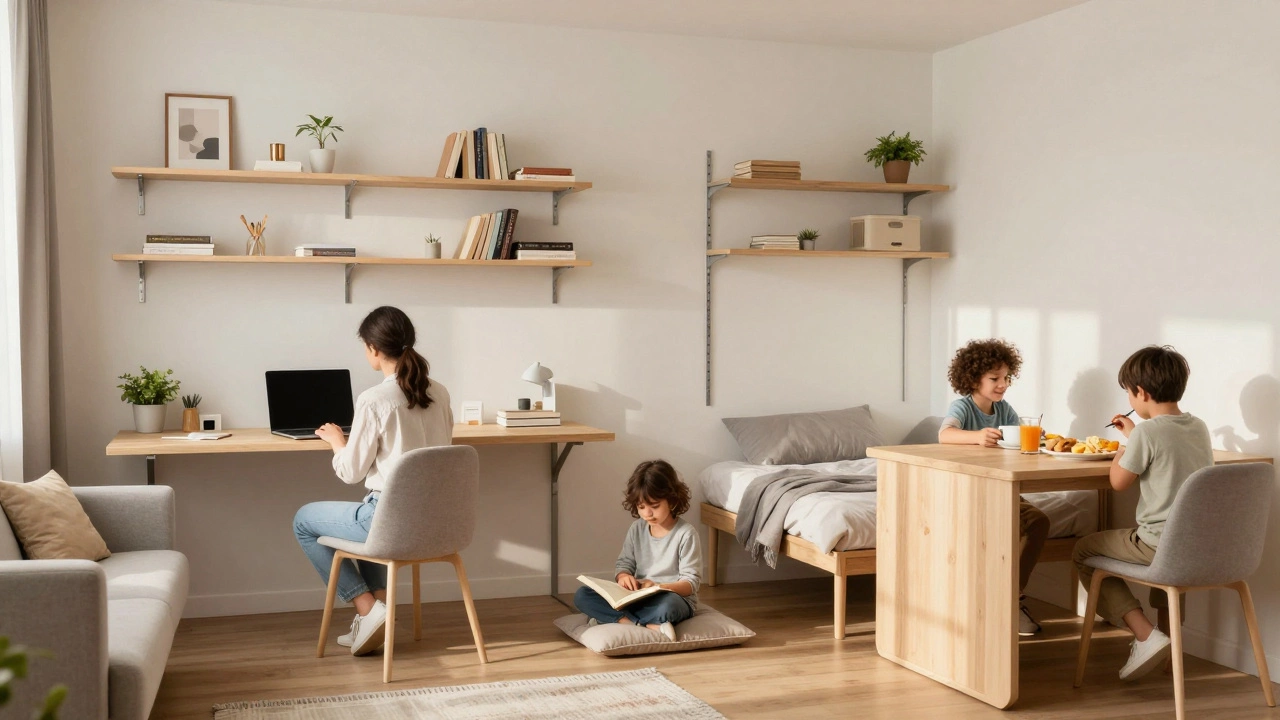
- Use vertical space: Install shelves, hanging organizers, wall-mounted desks. Every inch counts.
- Invest in multi-use furniture: A sofa bed, a dining table that folds down, storage ottomans. Avoid bulky pieces.
- Define zones: Use rugs, curtains, or lighting to separate sleeping, working, and living areas - even if they’re in the same room.
- Set rules: Quiet hours. Bathroom schedule. Laundry days. Write them down. Stick to them.
- Go minimal: If you don’t use it, don’t keep it. Clutter makes small spaces feel smaller.
One family in Unley started a “one in, one out” rule. Every new item - a shirt, a book, a gadget - means something else goes. They’ve reduced their clutter by 60% in six months.
Is There a Better Option?
Yes. If you’re thinking of moving into a 1000 sq ft apartment with three or more people, ask yourself: Is this temporary? If yes, maybe it’s fine. If it’s meant to be long-term? You’re setting yourself up for burnout.
Consider a 1200-1400 sq ft unit. It’s not much more expensive - maybe $50-$100 extra per week. But you gain:
- A dedicated home office
- More closet space
- Room for a proper dining table
- Privacy for teens or remote workers
That extra 200 sq ft isn’t luxury. It’s sanity.
Final Take
A 1000 sq ft 2BHK apartment is designed for two people. Maybe three, if you’re okay with compromise. Four? It’s possible - but it’s a survival strategy, not a lifestyle. And if you’re living like that, you’re not just cramped. You’re paying for stress.
Don’t confuse affordability with suitability. A bigger place might cost more, but it saves you in sleep, energy, and peace of mind. In the long run, space isn’t a luxury. It’s a necessity.
Can four adults live in a 1000 sq ft 2BHK apartment?
Technically, yes - but it’s not practical. Four adults would mean no private bedrooms. Everyone would need to share sleeping space, likely using a sofa bed or floor mattresses. There’s no room for work, storage, or quiet time. Most landlords and councils discourage this due to safety and habitability rules. In Adelaide, while not illegal, it’s rarely approved for long-term occupancy.
Is a 1000 sq ft apartment too small for a family?
It depends on the family. A couple with one young child (under 8) can manage fine. Two adults and two kids? Possible, but tight. The second bedroom becomes a shared space for kids, and the living room doubles as a play area, homework zone, and occasional sleeping spot. Families with teens or remote workers will struggle. The lack of private space and storage leads to daily friction. A 1200 sq ft unit is a much better fit for families.
What’s the minimum space needed per person in an apartment?
Experts recommend at least 150-200 sq ft per person for comfort, especially if they’re adults. That includes room to move, store belongings, and have personal space. In a 1000 sq ft apartment, that means a maximum of five people - but only if everyone is a child. For adults, 2-3 is the realistic upper limit. Anything beyond that leads to overcrowding, which affects mental health and sleep quality.
Do Australian building codes limit how many people can live in an apartment?
No national law sets a strict limit, but local councils do. In South Australia, the Building Code requires adequate plumbing, ventilation, and emergency exits. A 1000 sq ft 2BHK with four adults may violate these standards if the bathroom or kitchen can’t handle the load. Landlords who rent to more than four occupants risk fines. Councils often investigate complaints about overcrowding - especially if there are noise, hygiene, or safety issues.
How does apartment size affect mental health?
A 2023 study from the University of South Australia tracked 1,200 urban households. Those living in apartments under 1100 sq ft with three or more adults reported 47% higher stress levels than those in larger units. Lack of privacy, constant noise, and inability to escape personal space were the top causes. Overcrowding also reduces sleep quality and increases conflict. Space isn’t just about comfort - it’s a mental health factor.