Maryland Eviction Process Calculator
Required Action Plan
Description goes here.
Estimated Timeline
- Earliest Court Filing Date: --/--/----
- Estimated Hearing Window: -- days after filing
- Total Estimated Duration: -- weeks
Select a reason and date to generate your specific eviction roadmap.
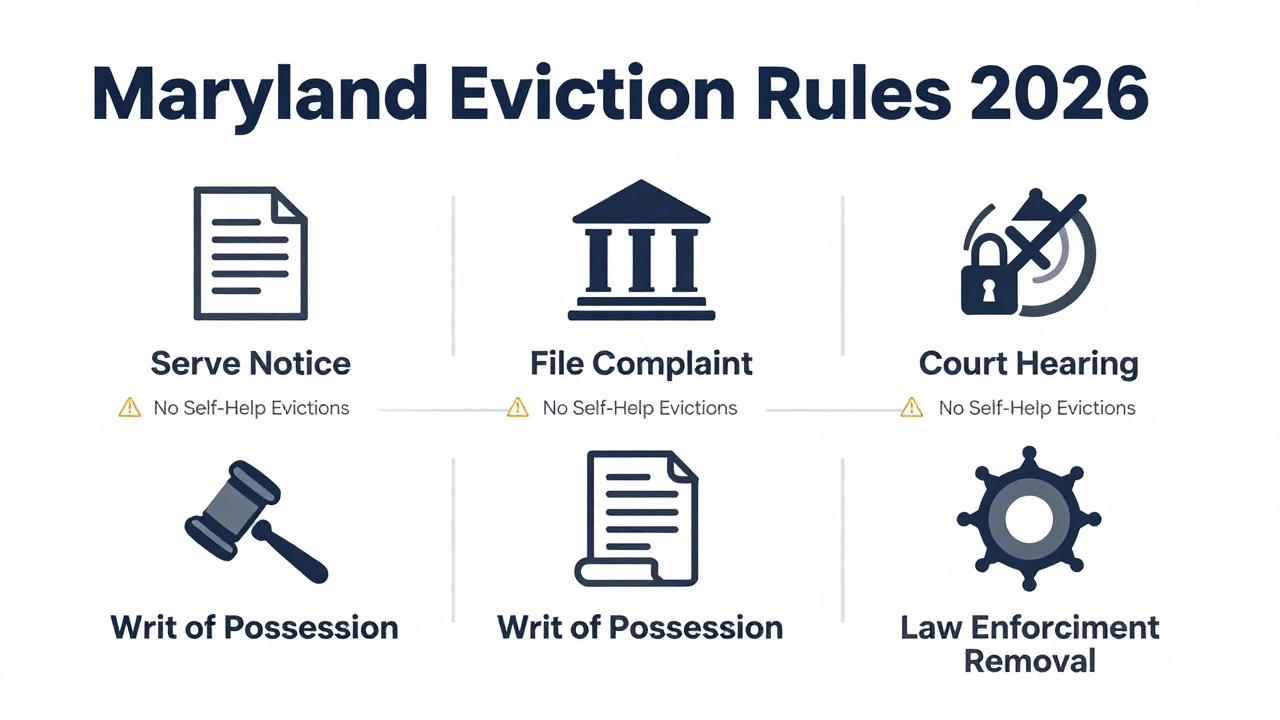
The Legal Process Flow
Serve Correct Notice
Wait for the statutory period (15 or 30 days). Tenant must vacate or cure.
File Complaint
File 'Complaint for Summary Ejectment' in District Court ($80-$150 fee).
Court Hearing
Present evidence. Judge rules on possession. Wait 10-14 days for writ eligibility.
Writ of Possession
Sheriff posts notice (24-48 hrs). Sheriff removes tenant if they don't leave.
It is July 2026, and the housing market in Maryland remains tight. If you are a landlord wondering if you can kick out a non-paying or problematic tenant immediately, the short answer is no. You cannot simply change the locks or throw their belongings on the curb. Doing so is illegal and could cost you thousands in damages.
The rules for evicting tenants in Maryland have been strict for years, but recent legislative updates in 2025 and early 2026 have tightened procedures further to protect renters from wrongful displacement. Whether you are dealing with unpaid rent, lease violations, or the end of a tenancy, you must follow a specific legal path known as the "summary ejectment" process.
The Golden Rule: No Self-Help Evictions
Before we look at the steps, let's clear up the biggest myth. In Maryland, landlords are strictly prohibited from using "self-help" measures to remove a tenant. This means you cannot:
- Change the locks while the tenant is inside.
- Shut off utilities (water, heat, electricity) to force them out.
- Remove doors, windows, or essential appliances.
- Threaten physical violence or harassment.
If you do any of these things, the tenant can sue you under the Maryland Tenant Protection Act. Courts often side with tenants in these cases because they view self-help as a breach of the covenant of quiet enjoyment. You will likely have to pay for their hotel stay, moving costs, and potentially punitive damages. Always use the courts.
Step 1: Serve the Correct Notice
You cannot file for eviction without first giving the tenant a formal written notice. The type of notice depends entirely on why you want them to leave. Getting this wrong is the most common reason evictions fail.
| Reason for Eviction | Notice Type | Timeframe Required |
|---|---|---|
| Non-payment of rent | 30-Day Notice to Quit | Tenant has 30 days to pay or leave. If they don't pay by day 30, you can file. |
| Lease violation (curable) | 15-Day Notice to Cure or Quit | Tenant has 15 days to fix the issue (e.g., remove unauthorized pet). If fixed, eviction stops. |
| Lease violation (uncurable/severe) | 15-Day Notice to Quit | For serious issues like drug activity or major property damage. No chance to fix. |
| Month-to-month tenancy ending | 30-Day Notice to Quit | Must be given at least 30 days before the next rent due date. |
| No cause (Fixed-term lease ended) | 30-Day Notice to Quit | Only allowed after a fixed lease expires. Cannot be used during a lease term. |
How you serve this notice matters just as much as the content. In Maryland, you can serve it personally (handing it to the tenant), by certified mail, or by posting it on the door AND mailing a copy. Keep proof of service. If the tenant claims they never got it, your case gets delayed or dismissed.
Step 2: File a Complaint in District Court
If the tenant stays past the deadline in your notice, you move to the court system. In Maryland, residential evictions are handled by the District Court, not the Circuit Court. You need to file a "Complaint for Summary Ejectment."
You can file this online through the Maryland Judiciary's electronic filing system or in person at the clerk's office in the county where the property is located. There is a filing fee, which varies by county but typically ranges between $80 and $150. Once filed, the court will schedule a hearing. Usually, you have to wait at least 10 days after filing before the hearing date to give the tenant time to respond.
Step 3: The Court Hearing
This is where many landlords make mistakes. They show up with emotions instead of evidence. The judge doesn't care about how frustrated you are; they care about facts. Bring:
- A signed copy of the lease agreement.
- Proof of rent payments (or lack thereof).
- Copies of all notices served and proof of delivery.
- Photos of property damage or logs of lease violations.
- Witnesses if applicable.
The tenant will have a chance to present their side. They might claim they paid cash, that the unit was uninhabitable (the "repair and deduct" defense), or that you retaliated against them for reporting code violations. Under Maryland law, retaliation is a valid defense. If you tried to evict them shortly after they complained about mold or broken heating, the judge may dismiss your case.
Step 4: Obtaining the Writ of Possession
If the judge rules in your favor, you get a judgment for possession. However, the tenant still isn't out yet. You must ask the court for a "Writ of Possession." This is the only document that authorizes law enforcement to remove the tenant.
In most Maryland counties, there is a mandatory waiting period after the judgment before you can request the writ. Often, this is 10 to 14 days. During this time, the tenant can still appeal or negotiate a payment plan. If they agree to pay what they owe plus costs, you might choose to drop the eviction. If not, you get the writ.
Step 5: Law Enforcement Removes the Tenant
Take the Writ of Possession to the local sheriff's office or marshal. They will schedule a time to go to the property. A deputy will post a notice on the door, usually giving the tenant 24 to 48 hours to vacate voluntarily. If they don't leave, the sheriff returns, changes the locks, and removes the tenant's belongings to a storage facility.
Do not try to speed this up. Only the sheriff can legally remove the person. If you interfere, you risk criminal charges.
Special Considerations for 2026
Maryland has seen increased scrutiny on "no-cause" evictions in cities like Baltimore and Montgomery County. While state law allows landlords to end month-to-month tenancies without a specific reason, some local jurisdictions have added additional requirements or longer notice periods for certain affordable housing units. Always check your local county ordinances.
Additionally, the federal Fair Housing Act still applies. You cannot evict a tenant based on race, color, religion, sex, national origin, familial status, or disability. Retaliatory evictions are also banned. If a tenant has a service animal and you try to evict them for having a pet when the lease prohibits pets, you are violating federal law, and the eviction will fail.
Common Pitfalls to Avoid
- Ignoring the Lease Terms: If your lease says rent is due on the 1st, and you accept late payment every month for six months, you may have "waived" the right to evict for late rent until you give a new notice reinstating the rule.
- Poor Documentation: Verbal agreements are hard to prove. If you agreed to repair a leak in exchange for lower rent, write it down. Without paper trails, judges guess, and guesses rarely help landlords.
- Rushing the Process: Trying to skip the notice period or the court hearing leads to dismissal. Patience saves money.
- Not Checking Local Rent Control: Some parts of Maryland have rent stabilization laws. Ensure you aren't violating caps on rent increases that could trigger a defense.
What If the Tenant Leaves But Owes Money?
Eviction is about getting the property back, not the money. If the tenant moves out before the court date, you still need to cancel the eviction proceedings regarding possession. However, you can sue them in small claims court or civil court for unpaid rent and damages. You will need to file a separate lawsuit for monetary judgment. The security deposit can cover some of this, but you must provide an itemized list of deductions within 45 days of the tenancy ending.
How long does an eviction take in Maryland?
On average, an uncontested eviction in Maryland takes 2 to 3 months from the initial notice to the actual removal of the tenant. This includes the 30-day notice period, the court scheduling delay (usually 10+ days), the hearing, the waiting period for the writ, and the sheriff's execution. Contested cases can take 6 months or longer.
Can I evict a tenant for having too many guests?
Only if your lease explicitly limits overnight guests or defines household size. If the lease is silent, it is difficult to evict solely for guests unless they cause disturbances or violate noise ordinances. You would need to serve a 15-Day Notice to Cure or Quit, citing the specific lease clause.
Do I need a lawyer for an eviction in Maryland?
You are not required to have a lawyer, but it is highly recommended, especially in urban areas like Baltimore where tenants often have legal representation. Many landlords hire attorneys for the court hearing to ensure proper procedure. Legal aid organizations often represent low-income tenants, so going pro se (without a lawyer) puts you at a disadvantage.
What happens if the tenant ignores the court summons?
If the tenant fails to appear in court after being properly served, the judge will likely grant a default judgment in your favor. You can then proceed to request the Writ of Possession. Do not assume they are gone; you still need the sheriff to legally remove them.
Can I keep the security deposit if the tenant owes rent?
Yes, but you must follow strict rules. You must provide an itemized statement of deductions within 45 days of the tenant leaving. If you withhold the entire deposit without explanation, the tenant can sue for double the amount. Use the deposit to offset unpaid rent and damages, but document everything.
Navigating Maryland eviction laws requires patience and precision. The system is designed to prevent abuse, so cutting corners will backfire. Stick to the paperwork, respect the timelines, and let the courts do the heavy lifting. If you are unsure, consult a local real estate attorney before serving any notice.