Non-Resident Property Cost Estimator
Transaction Details
Enter details to see your estimated non-resident liabilities.
The Day Your Status Changed Without You Noticing
You moved back to your home country last year. You kept the apartment in Sydney because the rental yield was good. You signed up for a new bank account overseas. You thought you were just managing an investment from afar. Then, the tax bill arrived, and it looked nothing like what you paid before. The letter mentioned "non-resident withholding" and a higher stamp duty rate on a potential second purchase. Suddenly, the word non-resident wasn't just a label; it was a financial reality that changed how much you pay, how you register property, and even how long you can stay in certain countries.
This shift happens more often than people expect. Residency isn't about where you own land or where your passport says you're from. It's a legal construct defined by tax authorities and immigration bodies. For anyone buying, selling, or holding property across borders, understanding this definition is the difference between a smooth transaction and a costly compliance error. Let's break down exactly what triggers this status change and why it matters for your assets.
It’s About Taxes, Not Just Tourism
When we talk about being a non-resident in the context of property and finance, we are almost always talking about Tax Residency. This is different from Citizenship and different from Immigration Status. You can be a citizen of Australia but a tax resident of Germany. You can be a permanent resident of Canada but a tax resident of the United States. The key driver here is where you owe taxes on your worldwide income.
Most countries use one of two main tests to determine this:
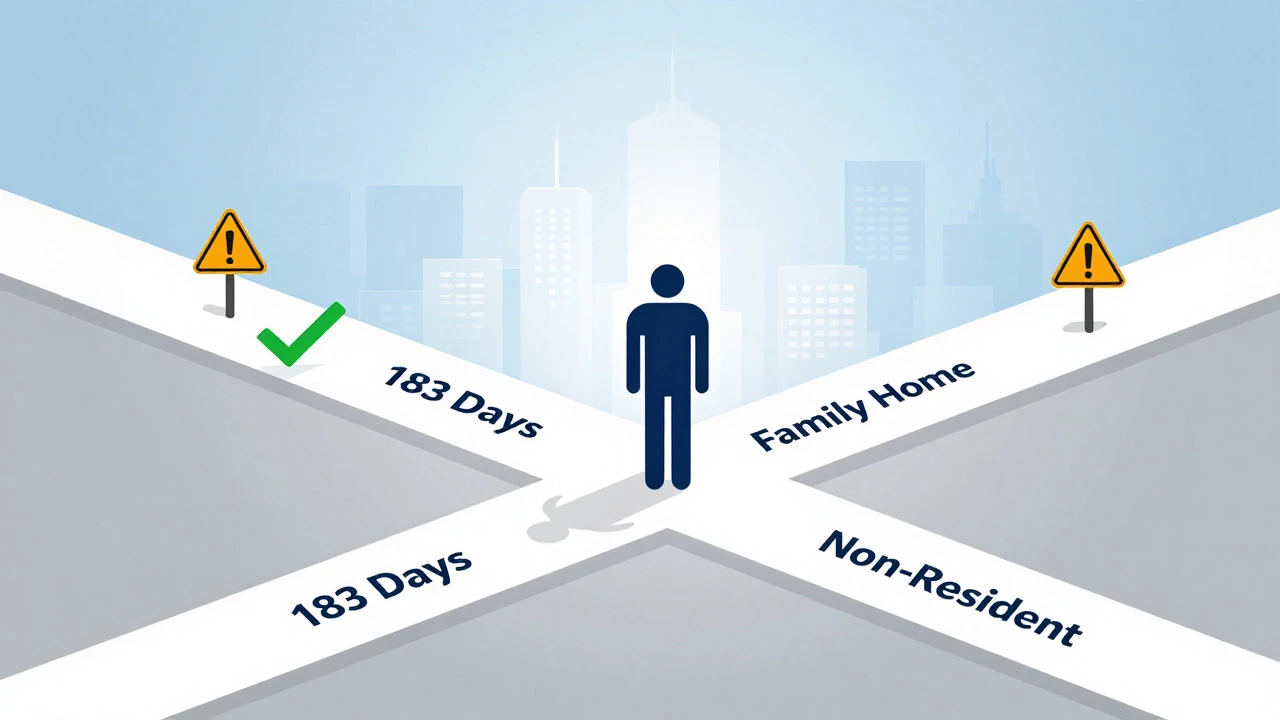
- The Physical Presence Test: How many days did you spend in the country during the tax year? In many jurisdictions, spending fewer than 183 days means you are likely a non-resident. However, some countries have tie-breaker rules if you split time evenly between two places.
- The Center of Vital Interests Test: Where is your life centered? This looks at where your family lives, where your social connections are, where you hold your primary bank accounts, and where you vote. If your heart and home are elsewhere, you might be deemed a non-resident even if you visit frequently.
For example, if you move to Singapore for work but keep your spouse and children in London, UK tax authorities may still consider you a UK tax resident depending on the specific statutory residence test rules. This distinction is critical because non-residents often face different tax rates, especially on passive income like rent or dividends.
Property Registration: The Extra Layer of Scrutiny
Once your tax status shifts to non-resident, the process of registering property changes. Governments want to ensure that foreign capital doesn't destabilize local housing markets. As a result, many regions have introduced additional layers of regulation specifically targeting non-residents.
In Australia, for instance, the Foreign Investment Review Board (FIRB) plays a central role. If you are classified as a non-resident, you generally cannot buy existing homes to live in yourself. You are usually restricted to purchasing new dwellings or vacant land with a commitment to build within a set timeframe. Failure to declare your non-resident status during the registration process can lead to severe penalties, including forced divestment of the property.
Similarly, in Canada, the Prohibition on the Purchase of Residential Property by Non-Canadians Act has restricted non-residents from buying homes in major urban centers to cool down overheated markets. While there are exceptions for temporary workers and international students, the burden of proof lies with the buyer. You must prove your eligibility before the title transfer is finalized.
This scrutiny extends to the registration itself. Title companies and conveyancers will ask direct questions about your residency status. They need to know if they should apply a Foreign Buyer Surcharge. In states like Victoria and New South Wales, this surcharge can add 7% to 8% on top of the standard stamp duty. That is a significant cost that only applies if you are correctly identified as a non-resident at the time of settlement.
The Hidden Costs: Stamp Duty and Withholding Taxes
Buying the property is just the start. Holding and eventually selling it comes with its own set of non-resident-specific costs. These aren't optional fees; they are mandatory withholdings designed to prevent tax leakage.
Consider rental income. If you own a commercial building or a residential unit while living abroad, the tenant or property manager often has to withhold a portion of the rent before paying you. In the US, this is known as FIRPTA (Foreign Investment in Real Property Tax Act) withholding. In other jurisdictions, it might be a flat percentage deducted at source. You then have to file a tax return in that country to claim back any excess withheld, which requires hiring a local accountant.
Then there is the sale. When a non-resident sells property, the proceeds are often subject to a withholding tax at the point of sale. The buyer's lawyer will hold back a percentage of the purchase price to send directly to the tax authority. This ensures the government gets its share before the money leaves the country. The rates vary wildly-some countries take 10%, others 25%. If you don't plan for this cash flow hit, you might find yourself short on funds when you think the deal is closed.
| Market | Purchase Restriction | Additional Duty/Surcharge | Sale Withholding Tax |
|---|---|---|---|
| Australia | FIRB approval required; mostly new builds | Up to 8% state-based surcharge | Varies by state; CGT implications |
| Canada | Ban on residential purchases in major cities | Non-resident buyer tax (varies by province) | 25% withholding (can be reduced with certificate) |
| United Kingdom | No general ban, but mortgage restrictions apply | 2% surcharge on top of SDLT | No automatic withholding, but self-assessment required |
| New Zealand | Overseas Investment Office approval needed | Bright Line Test applies differently | Withholding tax on interest/dividends |
How to Prove You Are (or Aren't) a Resident
If you are on the fence, how do you officially determine your status? There is no single global database. You have to look at the specific laws of the country where the asset is located. However, most authorities accept similar documentation to prove residency.
To prove you are a resident, you typically need:
- Tax Returns: Filed returns showing worldwide income declared locally.
- Utility Bills: Electricity, water, or internet bills in your name at a local address.
- Employment Contracts: Proof of local employment or business registration.
- Voter Registration: Active enrollment in local elections.
To prove you are a non-resident (often required for exemptions or specific loan products), you might need:
- Passport Stamps: Entry and exit records showing limited physical presence.
- Foreign Tax Identification Number (TIN): Evidence that you are taxed elsewhere.
- Lease Agreements: Rental contracts for a primary residence abroad.
Keep these documents organized. When you go to register a property, the conveyancer will ask for them. If you delay providing proof, the settlement date can slip, or worse, the extra duties get applied automatically because the system defaults to the safer, higher-tax category.

The Gray Area: Dual Residents and Tie-Breakers
Life isn't always black and white. Many professionals are "dual residents"-taxed as residents in both their home country and their host country. This happens when you meet the residency criteria for both nations simultaneously. To solve this, countries sign Double Taxation Agreements (DTAs).
These treaties include "tie-breaker" rules. Usually, the first step is looking at where you have a permanent home available. If you have homes in both, it looks at your center of vital interests (family and economic ties). If that's unclear, it looks at habitual abode. Finally, if all else fails, it may default to nationality. Understanding where you fall in this hierarchy is essential for property registration. If a DTA deems you a resident of Country A, you might avoid the non-resident surcharge in Country B, but you'll need to provide a Certificate of Residency from Country A's tax office to prove it.
Practical Steps Before You Sign Anything
If you suspect your status has changed, or if you are planning to buy property while living abroad, take these steps before making an offer:
- Check the Day Count: Calculate exactly how many days you spent in the property-holding country in the last 12 months. If you are close to the 183-day mark, consult a tax advisor immediately.
- Review Local Surcharge Laws: Look up the current foreign buyer or non-resident stamp duty rates in the specific state or province. These change frequently, as seen with recent updates in Ontario and New South Wales.
- Contact the FIRB or Equivalent Body: If applicable, submit a preliminary inquiry. Getting pre-approval can save weeks of delay during settlement.
- Prepare for Withholding: Assume you will lose 10-25% of your sale proceeds at closing unless you secure a clearance certificate beforehand. Factor this into your equity calculations.
- Update Your Will: Non-resident estate planning is complex. Ensure your local executor has the power to deal with foreign assets, or appoint a local co-executor.
Being a non-resident doesn't mean you can't own property. It just means the game is played by different rules. By identifying your status early, gathering the right proof, and accounting for the extra costs, you protect your investment from unexpected liabilities. The paperwork is heavier, but the clarity is worth it.
Does owning property make me a tax resident?
Generally, no. Simply owning real estate does not automatically make you a tax resident. Tax residency is determined by physical presence (days spent in the country) and the center of your vital interests (family, social, and economic ties). However, owning property can be evidence used by tax authorities to argue that you have strong ties to the country, so it is a factor in the overall assessment.
Can I avoid the non-resident stamp duty surcharge?
In some cases, yes. If you become a permanent resident or citizen shortly after purchasing, you may be able to apply for a refund of the surcharge. Additionally, certain professions or diplomatic roles may be exempt. You must apply for these exemptions through the relevant state revenue office, usually within a specific timeframe after settlement.
What happens if I fail to disclose my non-resident status?
The penalties can be severe. Depending on the jurisdiction, you could face fines equal to a percentage of the property value, forced sale of the property within a set period, and interest on unpaid taxes. In Australia, for example, failing to get FIRB approval can result in the property being compulsorily acquired by the government.
How does non-resident status affect capital gains tax?
Non-residents often pay capital gains tax (CGT) on the full increase in value of the property, whereas residents might get discounts for long-term ownership. Furthermore, non-residents may not be able to offset losses against other types of income. Always check the specific CGT rules for the country where the property is located.
Do I need a local bank account to register property as a non-resident?
While not always legally required for registration, having a local bank account is highly recommended. It simplifies the payment of stamp duty, council rates, and insurance. Some lenders also require a local account to service a mortgage. Without one, transferring large sums for settlement can trigger anti-money laundering checks and delays.