Land Acreage Calculator & Visualizer
Enter Dimensions
* Assumes a rectangular plot. For irregular shapes, sum individual areas.
0 Acres
0 Square Feet
*Based on average US new home size of ~2,300 sq ft.
Enter length and width above to see detailed calculations and visualizations.
The Short Answer: No, It’s Not Quite That Simple
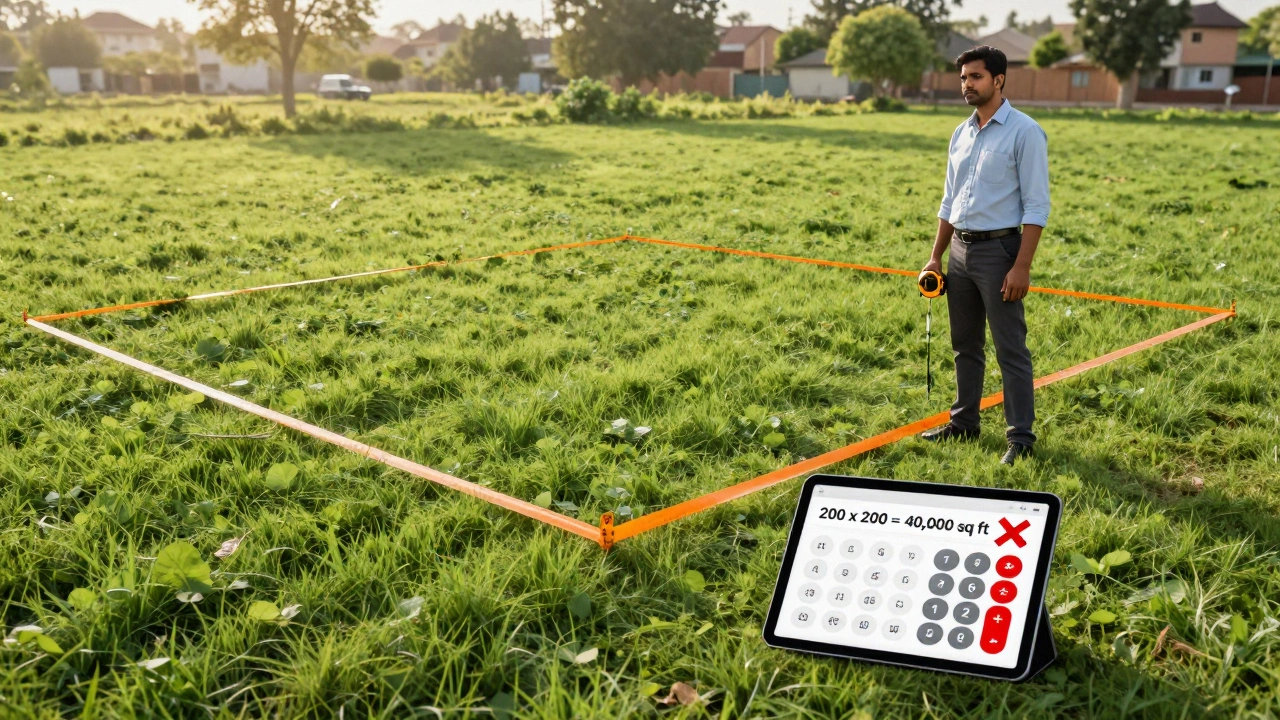
If you are looking at a plot of land listed as 200 feet by 200 feet, your first instinct might be to call it an acre. It feels right. It sounds big. But if you grab a calculator and multiply 200 times 200, you get 40,000 square feet. An actual acre is a unit of area equal to 43,560 square feet. So, that 200x200 lot is actually smaller than an acre by 3,560 square feet. That missing space is roughly the size of a standard two-car garage or a small backyard patio.
This misconception is incredibly common in real estate listings, casual conversations, and even among experienced buyers who just want a quick mental estimate. Understanding the exact math behind land measurements isn't just about being pedantic; it affects how much house you can build, where you can place a fence, and what the land is truly worth. Let's break down why this confusion happens, how to calculate true acreage, and what these numbers mean when you are standing on a piece of dirt ready to buy.
Why the 200x200 Myth Persists
Human brains love round numbers. We prefer squares because they are easy to visualize. When someone says "a quarter-acre," they often imagine a neat, tidy square. If an acre were exactly 40,000 square feet, the side length would be the square root of 40,000, which is roughly 200 feet (actually 199.99...). This proximity creates a cognitive shortcut. People round up for simplicity.
In the world of real estate, especially in suburban subdivisions, lots are often marketed with approximate dimensions. A listing might say "approx. 200x200" to give you a sense of scale without bogging you down in decimals. However, relying on this approximation can lead to significant errors when planning construction. Building codes often have strict setback requirements based on total square footage. If you assume you have an acre but only have 92% of one, your septic system placement or driveway width might violate local zoning laws.
Consider this scenario: You find a parcel advertised as "just under an acre." The seller mentions it measures 200x200. You plan a large detached workshop. Later, the surveyor reveals the true area is 40,000 sq ft. Your design requires 42,000 sq ft to meet fire safety setbacks. That "small" difference of 3,560 square feet just became a major redesign headache.
The Real Math Behind an Acre
To avoid these pitfalls, you need to anchor yourself in the correct constant. One acre equals exactly 43,560 square feet. This number comes from historical agricultural standards, specifically defined as an area of one chain (66 feet) by one furlong (660 feet). While most people don't measure land in chains anymore, the legacy remains in our modern units.
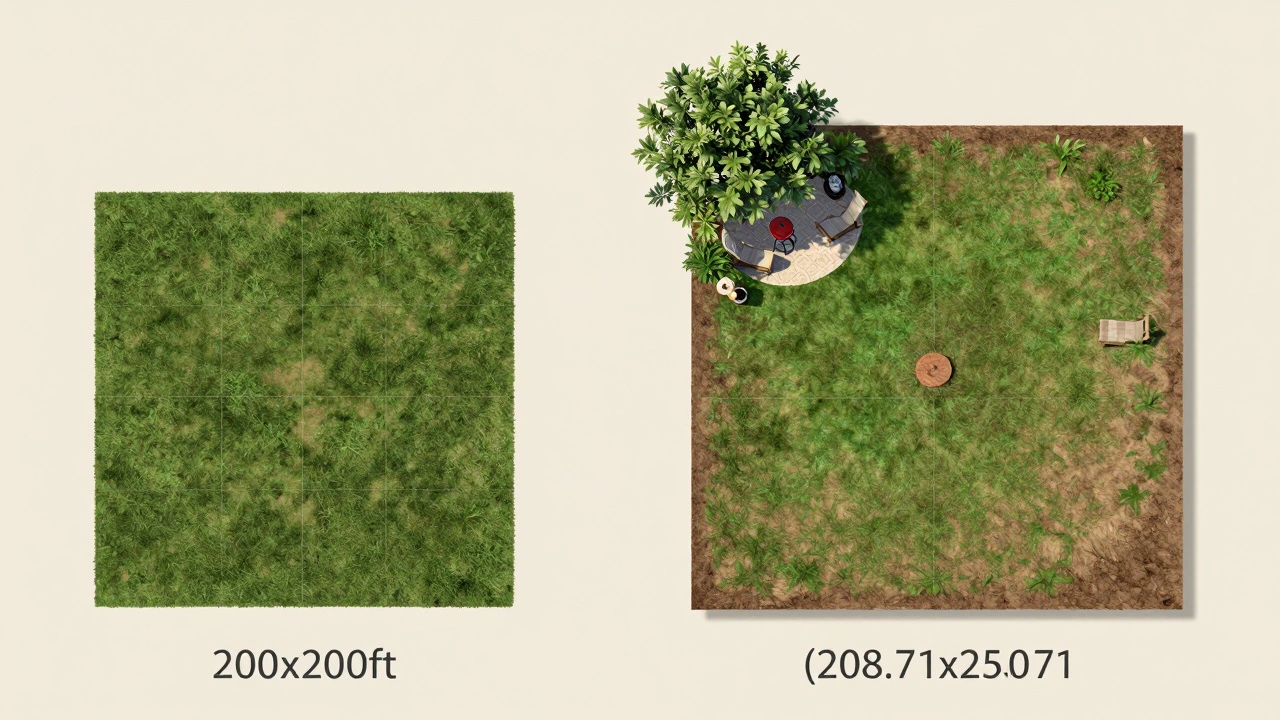
If you want a perfect square that represents exactly one acre, you need to take the square root of 43,560. The result is approximately 208.71 feet. So, a true square acre is 208.71 feet by 208.71 feet. Compare that to the mythical 200x200 square:
- Mythical Square: 200 ft x 200 ft = 40,000 sq ft
- True Acre Square: 208.71 ft x 208.71 ft = 43,560 sq ft
- Difference: 3,560 sq ft (about 8.2% less area)
That 8.2% difference is substantial. In commercial real estate, where value is calculated per square foot, that gap could represent thousands of dollars in lost potential revenue or higher costs per unit of land. For residential buyers, it might mean the difference between fitting a pool or not.
Visualizing the Difference
Numbers can be abstract. To really grasp the difference between 40,000 square feet and 43,560 square feet, let's look at everyday objects and spaces.
Imagine a standard American football field, including the end zones. That field covers about 53,500 square feet. One acre is roughly 80% of a football field. The 200x200 square is about 75% of a football field. The difference between them is roughly the size of a tennis court (approximately 2,800 square feet for doubles) plus a bit more. If you were walking across that missing 3,560 square feet, it would feel like losing a good-sized garden bed from every corner of your property.
Another way to think about it is in terms of housing. The average new home in the United States is around 2,300 square feet. The difference between a 200x200 plot and a true acre is enough space to build nearly 1.5 additional average-sized homes. While you wouldn't necessarily stack houses there, that extra space allows for wider setbacks, larger yards, or more flexible landscaping designs.
Common Land Shapes and Their Equivalents
Land rarely comes in perfect squares. Most parcels are rectangular, irregular, or triangular. Knowing how different shapes translate to acres helps you evaluate listings more accurately.
| Dimensions (Feet) | Total Square Footage | Acreage | Notes |
|---|---|---|---|
| 200 x 200 | 40,000 | 0.92 Acres | Often mistaken for an acre |
| 208.71 x 208.71 | 43,560 | 1.00 Acre | Perfect square acre |
| 100 x 435.6 | 43,560 | 1.00 Acre | Narrow, deep lot |
| 200 x 217.8 | 43,560 | 1.00 Acre | Rectangular acre starting at 200ft |
| 50 x 871.2 | 43,560 | 1.00 Acre | Very narrow, long strip |
Notice the last entry in the table above. If a listing says "200 feet wide," you need to know the depth to determine if it's an acre. If the depth is only 200 feet, you are short. If the depth is 217.8 feet, you have exactly an acre. Always ask for the full dimension set, not just the frontage.
How to Calculate Acreage Yourself
You don't need to be a mathematician to verify land sizes. Here is a simple step-by-step process to convert any rectangular plot into acres:
- Measure Length and Width: Get the dimensions in feet. If they are in meters, convert them first (1 meter = 3.28084 feet).
- Multiply for Square Footage: Multiply the length by the width. For example, 150 ft x 300 ft = 45,000 sq ft.
- Divide by 43,560: Take your total square footage and divide by 43,560. Using the example: 45,000 / 43,560 = 1.033 acres.
If the land is irregularly shaped, break it down into smaller rectangles or triangles. Calculate the area of each shape individually, sum them up, and then divide the total by 43,560. For complex plots, professional surveys using GPS or total stations provide the most accurate results, often down to the decimal point.
Many online tools offer "acreage calculators." These are convenient for quick estimates but should never replace a certified survey for legal transactions. They assume perfect geometric shapes, which rarely exist in nature.
Impact on Property Value and Zoning
Why does this precision matter beyond curiosity? Because land value is directly tied to usable space. In high-demand areas, developers pay premiums for every square foot. A lot that is 0.92 acres instead of 1.0 acre might seem negligible, but if the price per acre is $100,000, you are paying for space you don't have. Conversely, sellers might inflate perceived value by rounding up dimensions.
Zoning regulations also hinge on precise measurements. Minimum lot sizes for single-family homes are often set at 5,000, 10,000, or 43,560 square feet. If a county requires a minimum of one acre for a well permit or a specific type of agricultural use, having 40,000 square feet means you are disqualified. You cannot negotiate with zoning laws; you must meet the exact threshold.
Additionally, easements and rights-of-way can reduce usable acreage. A title search might reveal that a utility company has a 20-foot strip along one boundary. Even if the total footprint is 43,560 square feet, your buildable area might be significantly less. Always review the plat map alongside the dimensional data.
Frequently Asked Questions
Is 200x200 feet considered an acre?
No, 200x200 feet equals 40,000 square feet, which is approximately 0.92 acres. A true acre is 43,560 square feet. The difference is about 3,560 square feet.
What are the dimensions of a square acre?
A square acre measures approximately 208.71 feet by 208.71 feet. This is derived from taking the square root of 43,560.
How do I calculate acres from square footage?
Divide the total square footage by 43,560. For example, 87,120 square feet divided by 43,560 equals 2 acres.
Why is an acre 43,560 square feet?
The definition originates from medieval agriculture, defined as an area one chain (66 feet) wide by one furlong (660 feet) long. 66 multiplied by 660 equals 43,560.
Does the shape of the land affect its acreage?
No, the shape does not change the total acreage, only the usability. A square acre and a long, narrow acre have the same area, but building constraints may differ significantly.