Rental Property Profit Calculator
Property Details
Monthly Expenses
Results
There’s no magic number for how much profit you should make on a rental property. But if you’re aiming for less than 8% annual return after all costs, you’re probably not getting ahead. In Adelaide’s current market, a well-chosen property can easily clear $1,200 to $1,800 a month in net profit after mortgage, taxes, insurance, maintenance, and vacancies. That’s not luck-it’s math.
What Profit Actually Means for Rental Properties
Profit isn’t just the rent you collect. It’s what’s left after everything else gets paid. A lot of new investors think if they charge $2,500 a month in rent, they’re making $2,500 in profit. That’s not true. You’ve got the mortgage, property management fees (usually 8-10% of rent), council rates, water, insurance, repairs, and the occasional tenant who trashes the carpet. Then there’s vacancy-average in Adelaide is about 4-6 weeks a year. That’s 1-2 months of zero income.
Let’s say you buy a three-bedroom house in Norwood for $750,000. You put down 20%, so your mortgage is $600,000 at 6.5% interest. Your monthly repayment is about $3,800. Rent is $2,600. Sounds bad already? Wait-you’re not done.
Property management: $260. Council rates: $80. Insurance: $60. Water: $40. Maintenance reserve: $150. That’s $590 gone before you even think about repairs or vacancies. Now subtract that from $2,600. You’re left with $2,010. That’s your gross profit. But you still need to account for vacancy. If you’re vacant one month every 12, you lose $2,600. So annual net profit? Around $20,100 x 11 months minus $2,600 = $194,500? No. That’s not how it works.
Annual rent: $31,200. Annual expenses: $7,080 (monthly $590 x 12). Vacancy loss: $2,600. Net profit: $21,520. That’s 2.87% return on your $750,000 purchase price. That’s too low. You need to look at return on your actual cash invested, not the full price.
You put down $150,000. Your net profit is $21,520. That’s a 14.3% cash-on-cash return. Now we’re talking. That’s the number that matters.
The 1% Rule Is a Starting Point, Not a Rule
You’ve probably heard the 1% rule: rent should be at least 1% of the purchase price. So for a $750,000 property, rent should be $7,500 a month. That’s unrealistic in Adelaide. Most houses rent for $2,000-$3,000. The 1% rule works in cities with high demand and low prices-like parts of Texas or Ohio. It doesn’t apply here.
A better rule for Australia: aim for a gross rental yield of 4.5% or higher. That means annual rent divided by purchase price. For $750,000, that’s $33,750 in rent. That’s $2,812 a month. That’s achievable in suburbs like Burnside, Prospect, or Tea Tree Gully. But again-that’s gross. Net yield is what counts.
Net yield = (annual net profit / purchase price) x 100. For our example: $21,520 / $750,000 = 2.87%. That’s low. But if you bought the same house for $550,000 with the same rent and expenses? Net yield jumps to 3.9%. Better. If you put 30% down instead of 20%, your cash investment drops to $165,000, and your cash-on-cash return climbs to 13%.
Don’t chase yield alone. Location and capital growth matter. A property with 3% net yield that grows 7% a year will outperform a 5% yield property that barely moves.
What’s a Realistic Profit Target?
Here’s what successful investors in Adelaide aim for:
- Cash-on-cash return: 8-12%-This is your net profit divided by the cash you put in. If you put $150,000 down and make $15,000 net profit a year, that’s 10%. Solid.
- Net yield: 3-4%-After all expenses, including vacancy and capital works. Below 3% and you’re barely breaking even after inflation.
- Capital growth: 5-7% per year-This is where real wealth is made. A property that grows 6% a year doubles in 12 years. That’s the long game.
Many investors think they need to make $5,000 a month in profit. That’s rare. Even in high-demand areas like Glenelg or Norwood, you’re looking at $1,000-$1,800 net profit per month on a single property. That’s enough to cover a car payment, fund a holiday, or pay off credit cards. You don’t need to be rich to make money here-you just need to be smart.
Where to Find Properties That Deliver
Not all suburbs are created equal. In Adelaide, the best rental returns right now are in:
- Prospect-Average rent: $2,400. Median price: $680,000. Net yield: ~3.8%. High tenant demand from university staff and young professionals.
- Elizabeth-Average rent: $2,100. Median price: $510,000. Net yield: ~4.5%. Strong government investment in infrastructure.
- Port Adelaide-Average rent: $2,300. Median price: $590,000. Net yield: ~4.1%. Gentrification is accelerating.
- Modbury-Average rent: $2,200. Median price: $610,000. Net yield: ~3.9%. Family-friendly, good schools.
Avoid suburbs where prices are rising faster than rent. Places like Brighton or Unley have prices over $1.2 million but rent only $3,500. That’s a gross yield of 3.5% and a net yield under 2%. You’re paying for prestige, not profit.
What to Watch Out For
Here are the three biggest mistakes that kill rental profits:
- Underestimating maintenance-Roof repairs, plumbing, HVAC, pest control. Budget $1,000-$2,000 a year minimum. If you’re not setting aside money monthly, you’ll get blindsided.
- Choosing the wrong property manager-Some charge 12% and do nothing. Others charge 7% and handle everything from evictions to quarterly inspections. Ask for references. Check their vacancy rate over the last 12 months.
- Ignoring tax implications-Negative gearing means you can claim losses against your income. But if you’re not claiming depreciation (plant and equipment, building write-off), you’re leaving thousands on the table. Get a quantity surveyor’s report. It costs $600 but saves $3,000+ in the first year.
Also, don’t forget strata fees if you’re buying an apartment. They can be $1,000-$2,500 a year. That eats into your profit fast.
How to Increase Your Profit Without Raising Rent
You don’t need to scare tenants away with rent hikes to make more money. Here’s how to boost profit without touching the lease:
- Reduce vacancy-Keep the property in great condition. Clean, modern, well-lit. Tenants stay longer. Aim for 95% occupancy.
- Add value-Install solar panels. Tenants love lower bills. You get tax deductions and higher rent. In Adelaide, solar can add $100-$150 to monthly rent.
- Offer short-term rentals-If your property is in a tourist area like Glenelg or Victor Harbor, Airbnb can double your income. Just check local council rules.
- Bundle services-Include internet or cleaning in the rent. You get a bulk discount and charge more. Tenants appreciate the convenience.
One investor in Port Adelaide added a second bathroom for $25,000. Rent jumped from $2,100 to $2,700. He recovered the cost in 18 months. That’s not luck-it’s strategy.
When to Sell and When to Hold
Some investors sell after 5 years because they think they’ve made enough. But if your property is still growing 6% a year and you’re getting 10% cash return, why sell? Selling triggers capital gains tax. Holding longer reduces the tax burden.
Hold if:
- Your net return is above 8% cash-on-cash
- The suburb is still growing
- You’re not over-leveraged
Sell if:
- Rent won’t cover expenses even with a 5% increase
- The area is declining (crime up, schools closing, infrastructure abandoned)
- You’ve found a better opportunity with higher returns
Don’t sell because the market feels hot. Sell because the numbers no longer work.
Final Thought: Profit Is a Process, Not a Number
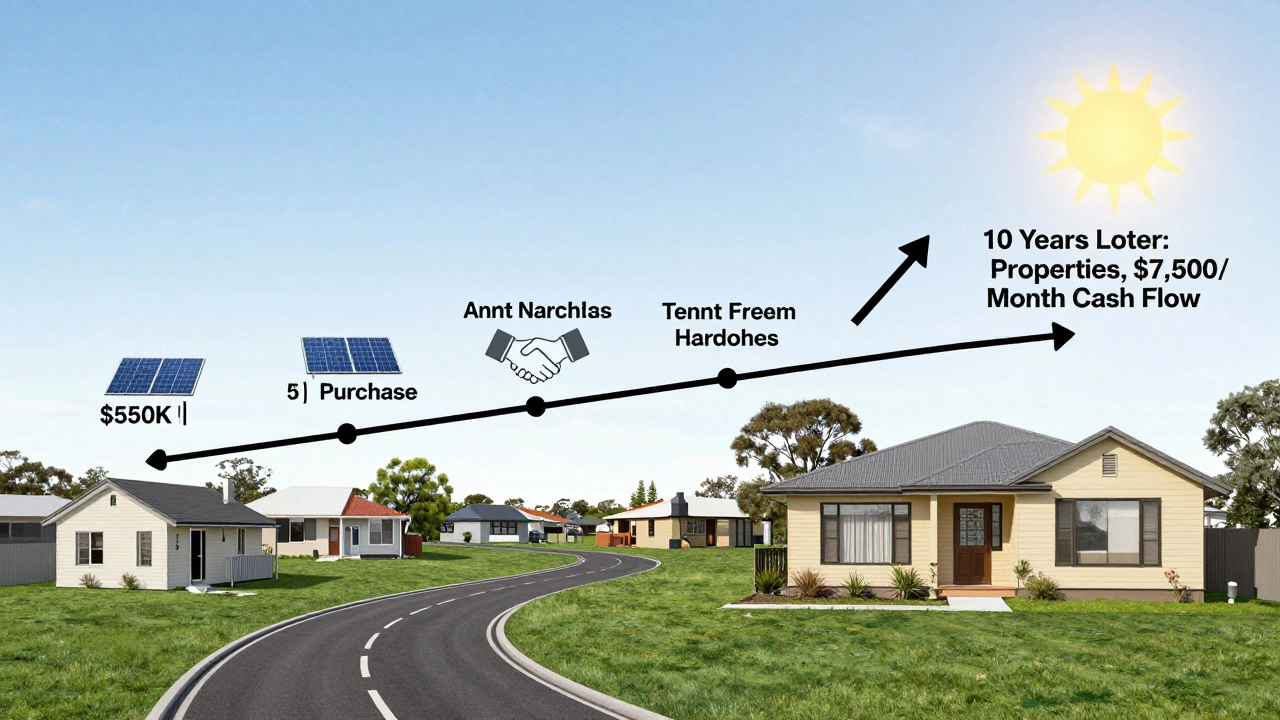
You won’t get rich overnight. But if you buy one property every 2-3 years, hold it for 10+, and reinvest the profit, you’ll build real wealth. The goal isn’t to make $10,000 a month from one house. It’s to own five houses that each make $1,500 net. That’s $7,500 a month. Passive. Reliable. Tax-effective.
Start with the numbers. Don’t fall in love with a house. Fall in love with the cash flow. Check the math before you sign. If it doesn’t add up, walk away. There will always be another property. But there won’t always be another chance to make smart money.
What’s a good rental yield in Adelaide right now?
A good gross rental yield is 4.5% or higher. That means annual rent should be at least 4.5% of the property’s purchase price. For a $600,000 home, that’s $27,000 a year in rent, or $2,250 per month. Net yield after all expenses should be 3-4%. Anything below 3% is risky unless you’re counting on big capital growth.
Is negative gearing worth it for rental property investors?
Negative gearing can be very useful if you’re in a high tax bracket. It lets you claim losses on your rental property against your salary income, reducing your taxable income. But it’s not a profit strategy-it’s a tax strategy. You’re still losing money each month. Only use it if you’re confident the property will grow in value over time and you can afford the shortfall.
How much should I budget for repairs each year?
Budget at least 1% of the property’s value per year for repairs and maintenance. For a $600,000 home, that’s $6,000 annually, or $500 a month. This covers things like appliance replacements, painting, plumbing fixes, and pest control. If you’re buying an older property, bump it up to 1.5-2%. Don’t skip this. A $5,000 roof repair can wipe out six months of profit if you didn’t save for it.
Should I use a property manager?
Yes-if you’re not living nearby or don’t have time. A good property manager saves you stress and money. They handle tenant screening, rent collection, inspections, and repairs. They typically charge 7-10% of rent. But a bad one can cost you more in vacancies and damage. Ask for their vacancy rate over the last 12 months. If it’s over 8%, find someone else.
Can I make more money with an apartment than a house?
Sometimes, but rarely. Apartments usually have lower capital growth and higher ongoing costs (strata fees). In Adelaide, a house in Prospect might cost $680,000 and rent for $2,400. A similar-sized apartment might cost $580,000 and rent for $2,100-but you’ll pay $1,800 a year in strata fees. That cuts your net profit. Houses tend to outperform apartments over time, especially in growing suburbs.