
Borrowing Power & Rate Comparison Calculator
Your Financial Profile
Estimated Borrowing Capacity
Based on max 43% DTI
Max Monthly P&I
With 700 Score
Est. Rate: 6.75%
Total Interest (30yr)
With 760+ Score
Est. Rate: 6.25%
Total Interest (30yr)
Enter your financial details to see how much you can borrow and how your credit score impacts costs.
Walking into a bank with a 700 credit score feels like standing on solid ground. It’s not perfect, but it’s good enough to get the door open. The real question isn’t whether you’ll get approved-it’s how much cash they’re willing to hand you. In the current market, that number swings wildly based on your income, debt, and where you live. Let’s cut through the noise and figure out exactly what your borrowing power looks like right now.
The Reality of a 700 Score: Good, But Not Great
First, let’s clear up what a 700 actually means. In the United States, where FICO scores range from 300 to 850, a 700 sits right at the border between "Good" and "Very Good." Lenders see you as reliable, but not exceptional. You won’t get the absolute rock-bottom interest rates reserved for those 760+ club members, but you’re far from the high-risk bucket that scares banks away.
In Australia, where I’m based in Adelaide, we use different models (Equifax or Experian) that often run higher numerically. A 700 there might be considered average or even slightly below depending on the specific model version. However, since this guide addresses the global concept of "borrowing power," we’ll focus on the universal mechanics lenders use: risk assessment. Whether you’re in New York or Sydney, a mid-tier score signals that you need to prove your stability through other metrics.
Is a 700 credit score considered bad?
No, a 700 is generally considered "good." It qualifies you for most conventional loans, though you may pay slightly higher interest than someone with a 750+ score.
The Math Behind Your Borrowing Limit
Lenders don’t just look at your score; they look at your Debt-to-Income Ratio (DTI). This is the percentage of your gross monthly income that goes toward paying debts. Most conventional lenders want your DTI under 43%, though some go up to 50% if you have significant savings.
Here is a rough heuristic for estimating your max loan amount:
- Calculate Monthly Gross Income: Take your annual salary before taxes and divide by 12.
- Subtract Existing Debts: Car payments, student loans, credit card minimums, and rent (if applicable).
- Determine Remaining Capacity: Multiply your remaining income by 2.5 to 3. This gives you a ballpark monthly mortgage payment you can afford.
- Convert to Loan Amount: Use a mortgage calculator. For example, if you can afford $2,000/month for principal and interest at a 6.5% rate over 30 years, your loan limit is roughly $240,000.
A 700 score helps you qualify for these standard terms. If your score were 620, you’d likely need a larger down payment and a lower DTI to get the same loan. If it were 780, you might squeeze in a higher DTI because the lender trusts you more.
Interest Rates: The Hidden Cost of a 700
This is where the rubber meets the road. A 700 score gets you approved, but it costs you money over time. In today’s market, the difference between a 700 and a 760 score can be 0.25% to 0.50% in interest rates.
Let’s look at a concrete example. Say you’re buying a $400,000 property with a 20% down payment ($80,000), leaving a $320,000 loan.
| Credit Score | Estimated Interest Rate | Monthly Payment (P&I) | Total Interest Paid (30 Years) |
|---|---|---|---|
| 700 | 6.75% | $2,060 | $421,600 |
| 760+ | 6.25% | $1,960 | $385,600 |
That extra $100 a month adds up to tens of thousands over the life of the loan. With a 700 score, you’re paying a premium for convenience. You’re telling the bank, "I’m safe, but I’ve had some hiccups in the past." They charge you for that uncertainty.
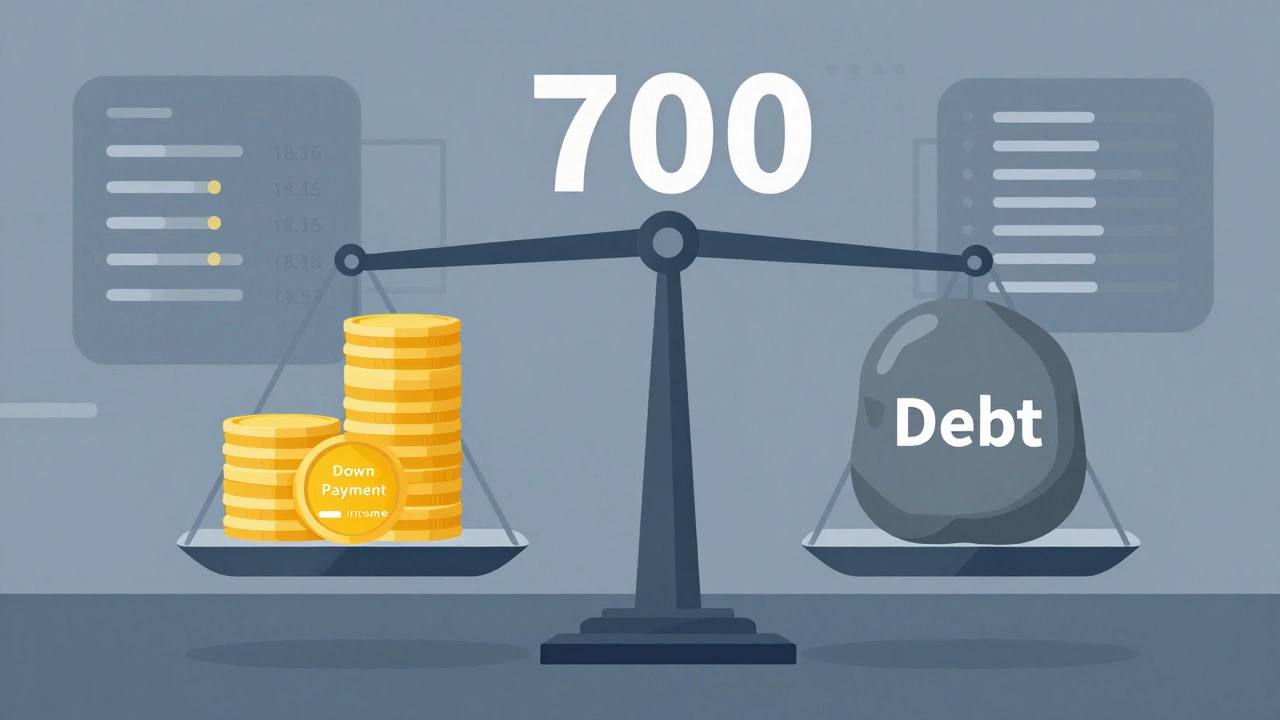
Down Payment Strategies for Mid-Tier Scores
If you have a 700 score, your leverage comes from your cash reserves. Lenders love borrowers who put skin in the game. Here’s how your down payment size affects your approval odds:
- 3.5% Down (FHA Loans): Possible with a 700 score, but you’ll pay Mortgage Insurance Premiums (MIP) for the life of the loan unless you refinance later. This is a common route for first-time buyers.
- 5-10% Down (Conventional): Doable, but you’ll still pay Private Mortgage Insurance (PMI). Your 700 score keeps PMI rates relatively low compared to sub-660 scores.
- 20% Down: This is the sweet spot. It eliminates PMI entirely. With a 700 score, putting 20% down shows the lender you aren’t trying to stretch too thin. It significantly boosts your approval chances and may help negotiate a slightly better rate.
Think of the down payment as an insurance policy for the lender. The bigger it is, the less they care about minor blemishes in your credit history.
What Lenders Look Beyond the Score
Your credit score is a summary statistic. Underneath it lies your credit report, which tells the full story. When you apply with a 700, underwriters will dig into three specific areas:
1. Recency of Negative Items
Did you miss a payment last year? Or five years ago? A 700 score with a recent late payment raises red flags. A 700 score with old, resolved collections looks much better. Lenders prefer "old news" over "breaking news."
2. Credit Utilization
If you have $10,000 in available credit and are using $9,000 of it, your utilization is 90%. Even if your score is 700, this suggests you’re living paycheck to paycheck. Aim to keep utilization under 30% before applying. Paying down cards right before closing can boost your score and show financial discipline.
3. Employment Stability
Two years of consistent employment is the gold standard. If you’ve changed jobs frequently, a 700 score won’t save you. Lenders want to know your income will continue after they lend you the money.
Boosting Your Power Before You Apply
You don’t need to wait years to improve your situation. Small tweaks can move you from the bottom of the "700" bracket to the top, potentially shaving basis points off your rate. Try these steps 3-6 months before applying:
- Dispute Errors: Pull your reports from Equifax, Experian, and TransUnion. Remove any inaccurate late payments or accounts that don’t belong to you. One removed negative item can jump your score by 10-20 points.
- Avoid New Credit: Every hard inquiry drops your score slightly. Don’t buy a car or open new cards while house hunting. Keep your profile static.
- Pay Down Revolving Debt: As mentioned, lowering credit card balances improves utilization. This is often the fastest way to bump your score.
- Become an Authorized User: Ask a family member with excellent credit and a long-standing account to add you as an authorized user. Their positive history can reflect on your report.

Special Programs for Borrowers with 700 Scores
If you’re struggling to meet conventional standards, government-backed loans offer lifelines. These programs are designed specifically for borrowers who are creditworthy but lack massive down payments or perfect scores.
FHA Loans are the most popular option. Backed by the Federal Housing Administration, they accept scores as low as 580 with 3.5% down. With a 700, you’re well within their comfort zone. The trade-off is the aforementioned MIP.
VA Loans, if you’re a veteran or active-duty service member, are incredibly powerful. They require no down payment and no PMI. While they technically accept lower scores, many lenders set their own floors around 620-640. A 700 score makes you a prime candidate for VA benefits, allowing you to borrow up to 100% of the home’s value.
USDA Loans target rural and suburban buyers. They also offer zero-down options. Eligibility depends heavily on the property location and your income level relative to the area median. A 700 score easily clears their typical minimum threshold of 640.
Regional Variations: Buying Property Online
The trend of buying property online has exploded. Platforms allow you to tour homes virtually, submit offers digitally, and close remotely. Does your credit score matter differently here? No. The digital process doesn’t change the underwriting criteria. However, online lenders (non-bank mortgage companies) sometimes have more flexible algorithms than traditional brick-and-mortar banks. They may weigh alternative data-like rent payments or utility bills-more heavily, which could benefit a borrower with a 700 score and a thin credit file.
In markets like Adelaide or Austin, where prices are rising, speed matters. An online pre-approval backed by a 700 score can make your offer look just as strong as a competitor with a 720, provided your cash position is equal.
Final Checklist for Maximizing Your Offer
Before you sign anything, run through this list:
- Get Pre-Approved, Not Just Pre-Qualified: Pre-qualification is a soft estimate. Pre-approval involves verifying your documents and checking your credit. Sellers take pre-approvals seriously.
- Shop Around: Get quotes from at least three lenders. One might offer a 6.5% rate for a 700 score, while another charges 7.0%. That difference is huge.
- Document Everything: Have two years of tax returns, W-2s, and bank statements ready. Clean documentation speeds up closing and reduces the chance of last-minute hiccups.
- Don’t Spend Money: Once you apply, do not buy furniture, pay off a large medical bill, or transfer funds between accounts without telling your loan officer. Sudden changes can derail approval.
A 700 credit score is a key that unlocks the door to homeownership. It won’t give you the VIP treatment, but it grants you access. By managing your debt, saving for a solid down payment, and choosing the right loan program, you can borrow confidently and secure a home that fits your budget. The market waits for no one, so prepare your finances and act when the right opportunity arises.
Can I get a mortgage with a 700 credit score?
Yes, absolutely. A 700 credit score qualifies you for conventional, FHA, VA, and USDA loans. You will likely receive competitive interest rates, though not the absolute lowest available.
How much house can I afford with a 700 credit score?
Your affordability depends more on your income and debt than your score. Generally, lenders suggest spending no more than 28-36% of your gross monthly income on housing costs. Use a mortgage calculator with your specific income to find your exact limit.
Does a 700 credit score affect my down payment requirement?
Not directly. You can still put down as little as 3.5% with an FHA loan. However, putting down 20% helps offset the slightly higher interest rates associated with a 700 score by eliminating Private Mortgage Insurance (PMI).
How fast can I raise my credit score from 700 to 720?
You can often see improvements in 1-3 months by paying down credit card balances to under 30% utilization and disputing any errors on your credit report. Avoid opening new credit lines during this period.
Is it better to shop for multiple mortgages with a 700 score?
Yes. Multiple inquiries for the same type of loan within a short window (usually 14-45 days) are typically counted as a single hard inquiry by credit scoring models. Shopping around ensures you get the best rate for your specific score profile.