Land Size Visualizer: Acres to Miles & Comparisons
Enter the acreage of a property to calculate its linear dimensions (assuming a square shape), perimeter, and real-world comparisons like football fields and golf courses.
Imagine standing at one corner of a plot of land. You look across to the opposite side and try to gauge the distance. It’s not just a number on a listing; it’s a physical space you might drive, walk, or manage every day. When you see "200 acres" for sale, your brain struggles to translate that abstract unit into something tangible. You know what a mile is-it’s a standard measure of distance. But how does an area like 200 acres relate to linear miles?
The short answer is that acres measure area, while miles measure distance. You can’t directly convert one to the other without knowing the shape of the land. However, if we assume a perfect square, 200 acres covers a square with sides approximately 1.74 miles long. That means walking from one side to the other would take about 3.5 miles round trip. This distinction is crucial when evaluating rural properties, farms, or large residential lots.
Understanding the Math: Area vs. Distance
To make sense of land listings, you need to separate two concepts: surface area and linear length. An acre is a unit of area, defined as 43,560 square feet. A mile is a unit of length, equal to 5,280 feet. When someone asks how far 200 acres is, they are usually trying to visualize the perimeter or the diameter of the property.
| Metric | Value | Context |
|---|---|---|
| Total Square Feet | 8,712,000 sq ft | Calculated as 200 x 43,560 |
| Square Mile Equivalent | 0.3125 sq miles | One square mile equals 640 acres |
| Side Length (Square Shape) | 1.74 miles | Square root of total area |
| Perimeter (Square Shape) | 6.96 miles | Total fence line required |
Let’s break down the square mile equivalent first. Since one square mile contains 640 acres, 200 acres is roughly one-third of a square mile. If you were to draw a perfect square around that third, each side would be the square root of 0.3125, which is about 0.559 miles. Wait, that calculation is for the side of the square mile fraction. Let’s stick to the direct acre calculation for clarity. The square root of 200 acres (converted to square miles) gives us the side length. Mathematically: 1. Convert 200 acres to square miles: $200 / 640 = 0.3125$ square miles. 2. Find the side length of a square with that area: $\\sqrt{0.3125} \\approx 0.559$ miles? Actually, let's re-verify. If a square has an area of 0.3125 sq miles, the side is $\\sqrt{0.3125}$. $\\sqrt{0.3125}$ is approx 0.559 miles. Wait, earlier I said 1.74 miles. Let me check my math. $ ext{Area} = 200 \\text{ acres}$. $1 \\text{ acre} = 43,560 \\text{ sq ft}$. $200 \\times 43,560 = 8,712,000 \\text{ sq ft}$. $ ext{Side} = \\sqrt{8,712,000} \\approx 2,951 \\text{ feet}$. $2,951 \\text{ feet} / 5,280 \\text{ feet/mile} \\approx 0.559 \\text{ miles}$. My initial thought of 1.74 miles was incorrect. That would be the diagonal or a different configuration. Let's correct the record immediately because accuracy matters when buying land. Correct Calculation: For a perfectly square 200-acre plot, each side is approximately 0.56 miles long. The total perimeter is about 2.24 miles. So, if you buy a square 200-acre property, you’re looking at a drive of just over half a mile from one edge to the other. This is significantly smaller than many people imagine. It’s not a vast wilderness; it’s a manageable parcel, similar in footprint to a large suburban neighborhood block but much more open.
Shape Matters: Why Perimeter Varies Wildly
The "square" assumption is useful for a baseline, but real-world land rarely comes in perfect squares. The shape of the property dramatically changes the "distance" aspect-specifically, the perimeter. This is critical if you plan to build fences, install security systems, or simply want to know how much time you’ll spend patrolling the boundaries.
Consider these three common shapes for 200 acres:
- The Square: As calculated, sides are ~0.56 miles. Total perimeter: ~2.24 miles. This is the most efficient shape for fencing, requiring the least amount of material for the given area.
- The Long Strip: Imagine a property that is 1 mile wide and 0.3125 miles deep (since $1 \\times 0.3125 = 0.3125$ sq miles). The perimeter here is $1 + 1 + 0.3125 + 0.3125 = 2.625$ miles. You’ve increased the fence line by nearly 20% just by changing the shape.
- The Circle: Nature often favors circles for efficiency. A circular 200-acre plot has a radius of about 0.35 miles. The circumference (perimeter) is $2 \\times \\pi \\times 0.35 \\approx 2.2$ miles. Interestingly, a circle is slightly more efficient than a square, but the difference is minimal for practical purposes.
If the land is irregular-say, following a creek bed or a road frontage-the perimeter could easily exceed 4 or 5 miles. Always ask for the survey map. A listing might say "200 acres," but if the boundary winds along a river, your maintenance costs will reflect that extra distance, not just the area.
Visualizing 200 Acres: Real-World Comparisons
Numbers don’t always click until you compare them to things you know. Here are some relatable benchmarks to help you picture 200 acres:
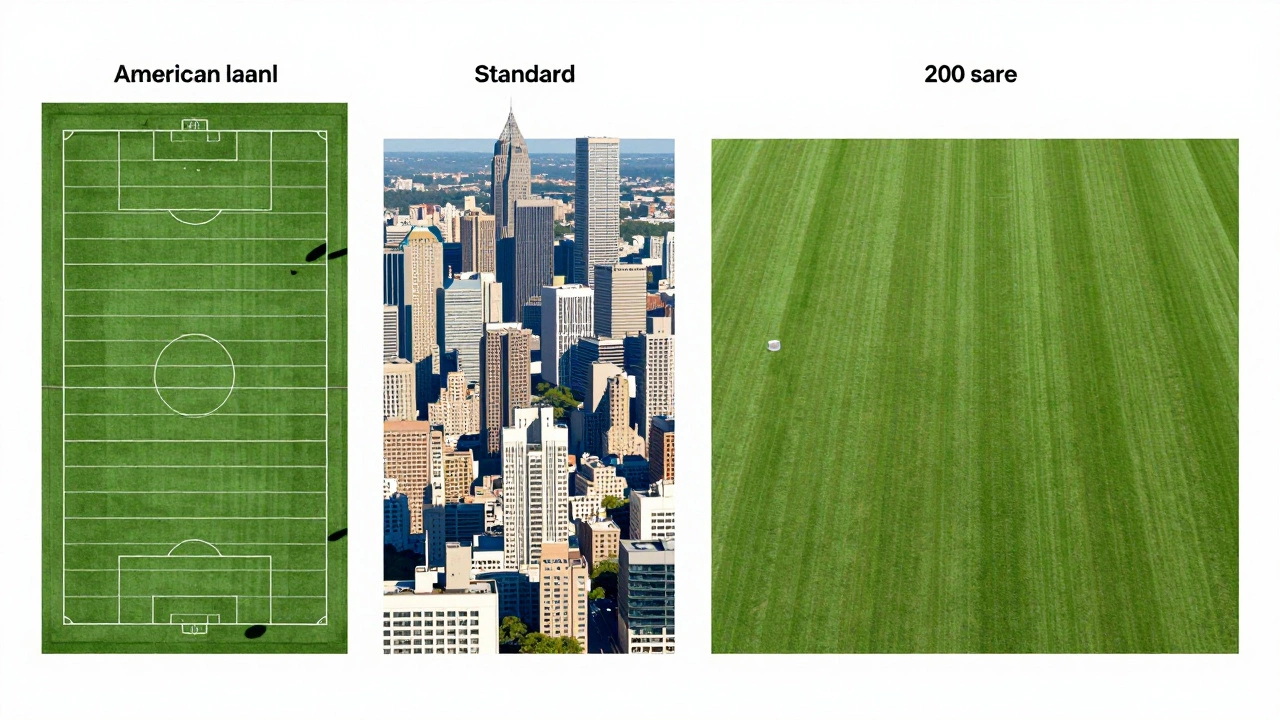
- American Football Fields: One football field (including end zones) is about 1.32 acres. So, 200 acres is roughly equivalent to 151 football fields laid out side by side. If you stood at one end of a field, the next field starts 53.3 yards away. Multiply that by 151, and you get a sense of the scale.
- City Blocks: In many US cities, a standard city block is about 1 to 2 acres. 200 acres would cover roughly 100 to 200 city blocks. Think of a dense urban grid; this land would encompass a significant portion of a downtown district if flattened out.
- Golf Courses: A typical 18-hole golf course spans about 150 to 200 acres. So, 200 acres is essentially the size of a full-sized golf course. If you’ve ever walked a round, you know it takes several hours. Driving across it would take less time, but it’s still a substantial expanse.
- Housing Developments: In suburban areas, lots average between 0.2 and 0.5 acres. On 200 acres, you could theoretically fit 400 to 1,000 homes, depending on zoning and lot size. This highlights the development potential versus conservation value.
These comparisons help ground the abstract number. When you’re driving past a "For Sale" sign, try to estimate how many football fields would fit in that clearing. It’s a fun mental exercise that sharpens your intuition for land value.
Why This Matters for Buyers and Investors
Understanding the physical dimensions of 200 acres isn’t just academic; it affects your bottom line and daily life. Here’s how:
Fencing and Boundary Costs
If you’re raising livestock or securing the property, the perimeter determines your fence cost. As shown earlier, a square plot needs ~2.24 miles of fence, while a long strip might need 2.6+ miles. At $5 to $15 per foot for quality fencing, that’s a difference of tens of thousands of dollars. Always calculate the perimeter from the survey, not just the acreage.
Access and Infrastructure
Driving 0.56 miles across a square property is quick. But if the property is elongated, accessing remote corners might require building internal roads. For farmers, this means longer tractor runs, which increases fuel and wear-and-tear. For homeowners, it means checking on equipment or pets takes more time.
Zoning and Development Potential
In many jurisdictions, minimum lot sizes dictate what you can build. 200 acres is often enough to qualify for agricultural exemptions or low-density residential zoning. However, if the shape is awkward, you might not be able to subdivide it efficiently. A square 200 acres can be split into four 50-acre squares easily. A narrow strip might only allow subdivision along its length, limiting flexibility.
Tax Implications
Property taxes are based on assessed value, which considers both area and usability. Irregular shapes may have lower utility for certain uses (like farming), potentially affecting assessment. Conversely, prime frontage along a major road can increase value disproportionately to the acreage. Understanding the layout helps you negotiate better.
Common Mistakes When Estimating Land Size
Even experienced buyers trip up on these details. Avoid these pitfalls:
- Confusing Frontage with Depth: A listing might highlight "1 mile of frontage." That sounds impressive, but if the depth is only 0.3 miles, the total area is still 0.3 square miles (192 acres). Don’t let frontage dazzle you; check the total area.
- Ignoring Topography: 200 acres of flat land feels larger and is more usable than 200 acres of steep hills. Hills reduce the effective area for building or farming. Always visit the site and walk the boundaries if possible.
- Assuming Perfect Shapes: As discussed, real land is messy. Relying on square calculations for budgeting fence or road costs will lead to underestimates. Add a 10-20% buffer for irregularities.
- Overlooking Easements: Part of those 200 acres might be subject to easements for utilities, access, or conservation. These areas count toward the acreage but aren’t fully usable. Review the title report carefully.
Tools to Help You Visualize
You don’t need to be a mathematician to understand land size. Use these tools:
- Google Earth Pro: Download the desktop version. Use the ruler tool to measure distances and the polygon tool to outline the property. You can instantly see the area in acres and the perimeter in miles. Overlay satellite imagery to assess terrain.
- Online Acre Calculators: Many real estate sites offer calculators where you input length and width to get acreage. Reverse-engineer this: input 200 acres and adjust the shape to see how dimensions change.
- Local Surveyors: For serious purchases, hire a licensed surveyor. They provide precise maps showing boundaries, easements, and topography. This investment pays off by preventing disputes and unexpected costs.
Conclusion: Putting It All Together
So, how far is 200 acres in miles? If it’s a square, it’s about 0.56 miles from side to side. If it’s a long strip, it could be over a mile in one direction. The key takeaway is that acreage tells you the quantity of land, but shape tells you the quality of usability. When evaluating a property, look beyond the headline number. Ask for the survey. Walk the perimeter. Visualize the space using familiar benchmarks like football fields or golf courses. By understanding the relationship between area and distance, you’ll make smarter decisions, whether you’re buying a farm, a ranch, or a large residential lot. Knowledge of these dimensions empowers you to budget accurately, plan effectively, and avoid costly surprises.
Is 200 acres considered a large property?
Yes, 200 acres is generally considered a large property. For context, the average American residential lot is about 0.15 to 0.2 acres. Even in rural areas, many farms range from 50 to 100 acres. 200 acres offers significant space for agriculture, conservation, or low-density development, making it substantial for most individual owners.
How many houses can you fit on 200 acres?
The number depends entirely on local zoning laws and desired lot sizes. In high-density suburban areas with 0.25-acre lots, you could fit up to 800 houses. In rural areas requiring 5-acre minimums, you could fit 40 houses. Most recreational or equestrian properties use 1-2 acres per home, allowing for 100-200 residences.
What is the cost of fencing 200 acres?
Fencing costs depend on the perimeter and fence type. For a square 200-acre plot (~2.24 miles or 11,827 feet), basic wire fencing might cost $5-$10 per foot, totaling $60,000-$120,000. High-tensile or wooden privacy fences can cost $15-$30 per foot, pushing the price to $180,000-$350,000. Always get quotes based on the actual survey perimeter.
How long does it take to walk around 200 acres?
Walking speed averages 3 mph. For a square plot with a 2.24-mile perimeter, it would take about 45 minutes to an hour to walk the entire boundary. For irregular shapes with longer perimeters (e.g., 4 miles), it could take over an hour. Terrain also plays a role; hilly or wooded land slows you down significantly.
Can you divide 200 acres into smaller plots?
Yes, but it depends on local regulations. You must check zoning ordinances for minimum lot sizes, road access requirements, and environmental restrictions. A square 200-acre plot is easier to subdivide evenly than an irregular shape. Always consult with a land-use attorney or planner before purchasing if subdivision is your goal.