Adelaide Home Cost Calculator: Buy vs Build
Build Your Home
Buy an Existing Home
Cost Comparison
| Cost Component | Build (Total) | Buy (Total) | Difference |
|---|---|---|---|
| Upfront Costs | $0 | $0 | |
| 5-Year Savings | $0 | $0 | |
| 10-Year Savings | $0 | $0 |
Key Insight: Building provides better long-term value in most cases. New homes typically have 30-50% lower energy costs and require less maintenance than older homes. Over 10 years, these savings can total $15,000-$25,000 compared to buying.
When you’re thinking about your next home in Australia, the big question isn’t just where you want to live-it’s whether it makes more sense to buy an existing house or build one from scratch. In 2025, with material costs still hovering above pre-pandemic levels and interest rates holding steady, this decision carries more weight than ever. The truth? There’s no one-size-fits-all answer. But if you know what you’re really paying for, you can make a smart choice that saves you tens of thousands over time.
What you actually pay when you buy a house
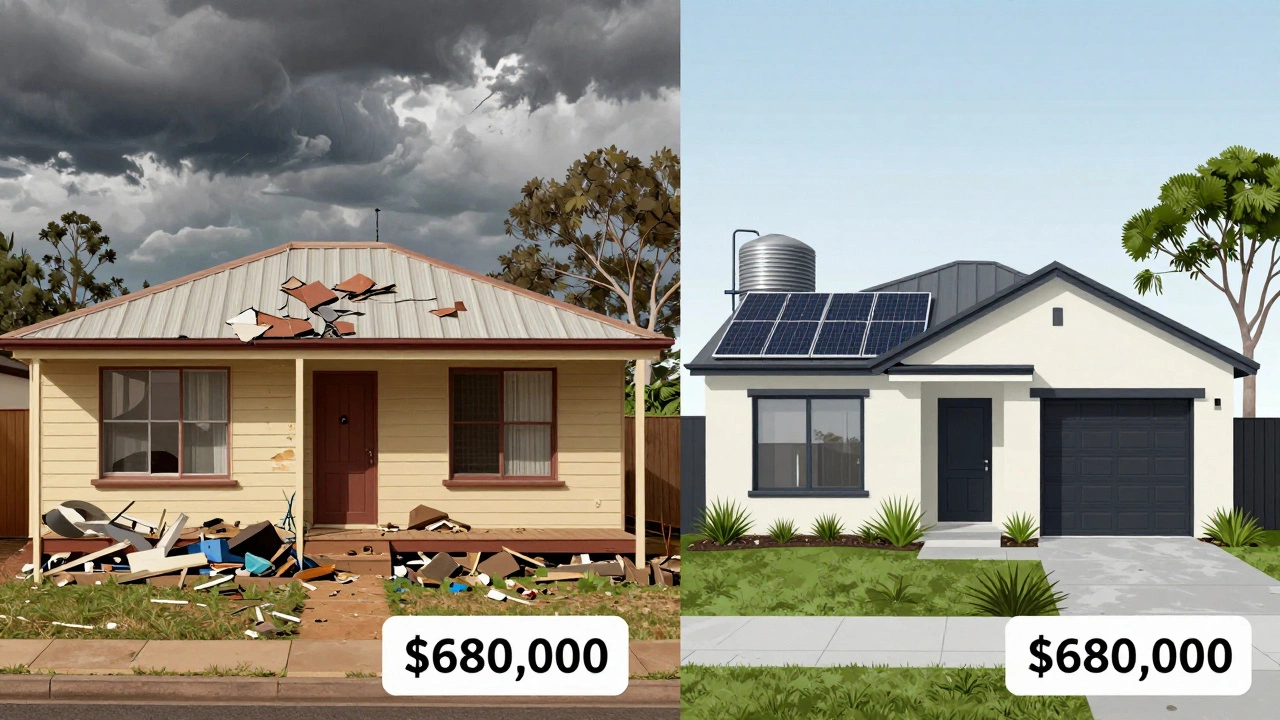
Buying an existing home sounds simple: you find a place, make an offer, and sign papers. But the sticker price is just the start. In Adelaide right now, the median price for a three-bedroom house is around $680,000. That might seem like a solid number-until you add the hidden costs.
Stamp duty alone can eat up $25,000 to $35,000 depending on the price and whether you’re a first-home buyer. Conveyancing fees? Around $1,500. Building and pest inspections? Another $800. Then there’s moving costs, connecting utilities, and maybe a new paint job or floor refinish if the previous owners didn’t leave it in great shape. If the house is older, you could be looking at $10,000 to $30,000 in repairs within the first year-new roof, faulty wiring, leaking pipes, or a failing HVAC system.
And don’t forget land value. In suburbs like Noarlunga or Mount Barker, you’re paying for decades of appreciation. You’re not just buying a house-you’re buying into a neighborhood that’s already priced in. That means less control over layout, design, or future upgrades. If you want an open-plan kitchen or a bigger backyard, you’re stuck with what’s there.
What it really costs to build your own house
Building a house sounds expensive. And it is-but not always in the way people think. The average cost to build a new three-bedroom home in South Australia right now is between $280,000 and $380,000. That includes everything: design, permits, materials, labor, and connections. That’s a range, not a fixed number, because the biggest variable is what you choose.
Here’s how it breaks down:
- Land purchase: $200,000-$350,000 (depending on location and size)
- Construction: $250,000-$350,000 (standard finishes)
- Design and engineering: $10,000-$20,000
- Permits and council fees: $5,000-$10,000
- Connections (water, power, sewer): $8,000-$15,000
- Landscaping and fencing: $10,000-$20,000
That brings your total to roughly $500,000-$700,000-similar to buying. But here’s the catch: you’re getting a brand-new home with no hidden issues, energy-efficient insulation, smart wiring, and a layout designed for your life. No one else lived in it. No one else messed with the plumbing. You get to choose every switch, tile, and cabinet.
And if you’re smart, you can save more. Buying land in a developing area like Salisbury East or Yatala can cost $150,000-$250,000-much cheaper than buying an established home in the same suburb. And if you do some of the work yourself-like painting, landscaping, or installing fixtures-you can knock $15,000-$25,000 off the total.
Why building often wins on long-term value
Let’s say you buy a 1980s house for $680,000. Five years later, you need a new roof ($18,000), a new hot water system ($3,500), and your insulation is falling apart so your power bills are climbing. You spend another $12,000 on upgrades to make it energy efficient. That’s $33,500 extra you didn’t plan for.
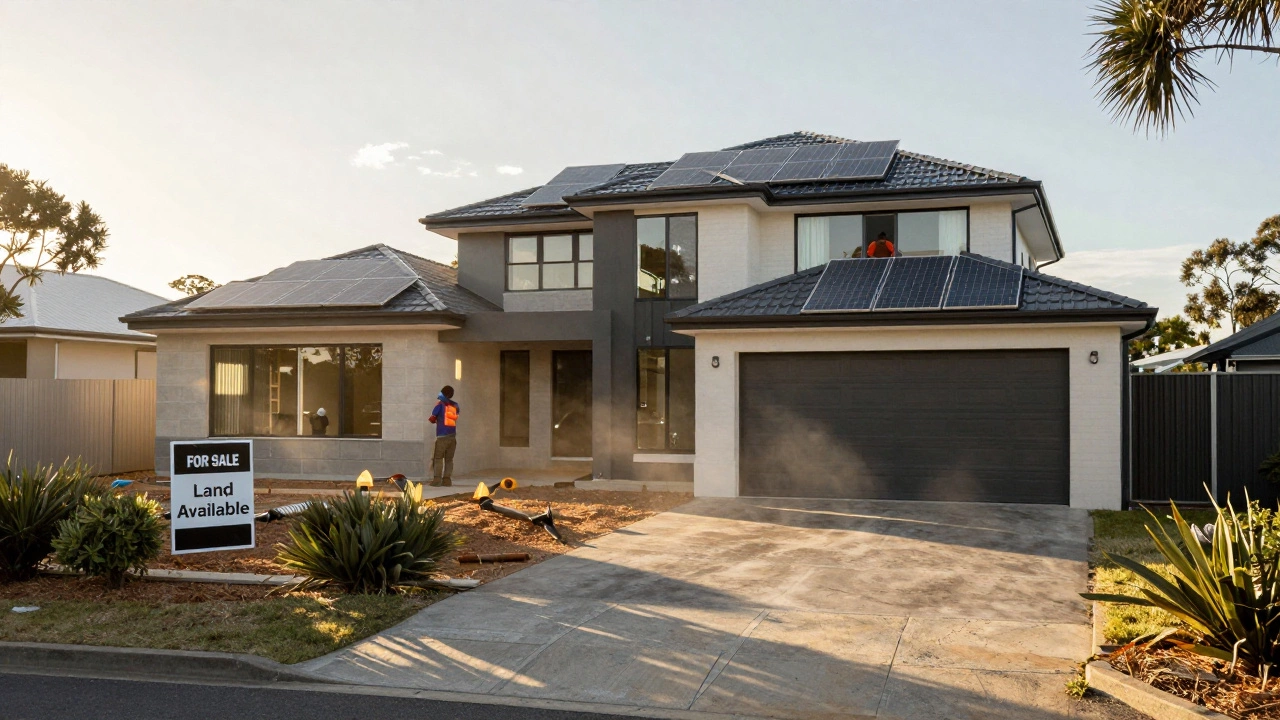
Now, picture a new build. Same price point. You pay $690,000 to build it. Five years later? Your roof is still under warranty. Your solar panels are generating power. Your double-glazed windows are keeping the heat out in summer and in during winter. Your power bill is 40% lower. You haven’t spent a cent on repairs.
Studies from the Master Builders Association show that new homes in Australia use 30-50% less energy than homes built before 2000. That’s $1,200-$2,000 a year saved on bills. Over ten years? That’s $20,000 in your pocket.
And resale value? New homes sell faster. In 2024, homes built after 2020 sold 22% quicker than those built before 2010, according to CoreLogic data. Buyers today want efficiency, space, and low maintenance. They’re willing to pay more for it.
The hidden risks of building
Building isn’t risk-free. Delays happen. Weather slows down concrete pours. Suppliers run short on timber or steel. Labor shortages mean your builder might be juggling five jobs at once.
And not all builders are equal. Some cut corners on insulation or use cheaper plumbing fittings to hit a price point. That’s why you need to do your homework. Check their license with Fair Trading SA. Ask for references from three recent clients. Visit a site they’re currently building. Look at the quality of finishes, how clean the site is, how organized the schedule looks.
Also, don’t skip the contract. A standard HIA or MBA contract protects you. It spells out what’s included, what’s not, and what happens if timelines slip. If your builder says, “We’ll just handle it,” walk away. That’s how you end up with a $100,000 bill for extras you didn’t agree to.
And then there’s the emotional toll. Building a house takes 8-12 months. You’re making dozens of decisions every week-tile color, benchtop material, light switches. It’s exhausting. If you’re not ready for that level of involvement, buying might be the better path.
When buying is the smarter move
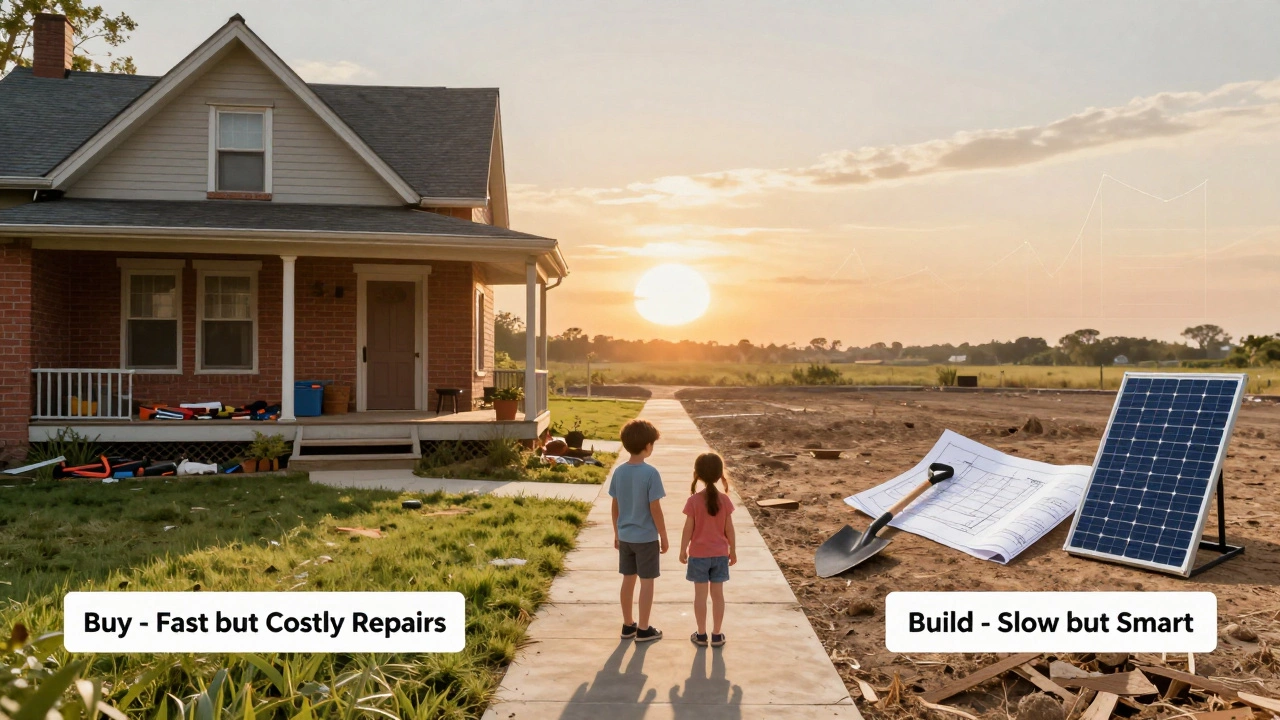
Building isn’t for everyone. If you need to move in fast-because of a job change, family situation, or just plain impatience-buying is the only option. If you’re not handy and don’t want to spend weekends at a construction site, buying saves you time and stress.
Also, if you’re looking at a small block in a prime location like Glenelg or Unley, you might not even be able to build. Zoning laws restrict new homes on lots under 400 square meters in many suburbs. You’re better off buying a renovated cottage than fighting council rules.
And let’s not forget the financing. Getting a construction loan is harder than a standard home loan. Banks want to see detailed plans, fixed-price contracts, and proof you can cover cost overruns. You might need a bigger deposit-20% or more. If your credit isn’t spotless, buying is easier.
Real examples from Adelaide in 2025
Take Sarah and Mark. They had $650,000 saved. They looked at three existing homes in the suburbs: one in Morphett Vale needed a new roof and rewiring ($35,000 extra), one in Plympton had a tiny kitchen and no backyard, and one in Seaton was overpriced for its condition. They walked away.
Instead, they bought a 600-square-meter block in Para Hills West for $240,000. They built a 180-square-meter home with a modern open-plan layout, solar panels, and a rainwater tank. Total cost: $625,000. They moved in 10 months later. Their power bill is $48 a month. They have a garden they designed. They didn’t pay a cent for repairs in the first year.
Compare that to James, who bought a 1990s house in Prospect for $670,000. He thought he got a good deal. Two years later, he spent $22,000 replacing the old ducted heating, $8,000 on waterproofing the bathroom, and $5,000 on new flooring. He’s still paying $220 a month on power.
Final decision checklist
Here’s how to decide for yourself:
- Can you wait 8-12 months? If not, buy.
- Do you have a clear idea of your ideal layout? If yes, build.
- Are you comfortable making hundreds of small decisions? If not, buy.
- Can you afford a 20% deposit plus extra for overruns? If yes, build.
- Is there a suitable block of land in your preferred area? If yes, building might be cheaper long-term.
- Are you okay with a home that might need repairs in 5-10 years? If yes, buying is fine.
There’s no right or wrong. But if you’re in it for the long haul-five, ten, twenty years-building gives you more control, lower running costs, and fewer surprises. Buying gives you speed and simplicity. Pick based on what matters most to you right now.
Frequently Asked Questions
Is it cheaper to build a house or buy one in Adelaide in 2025?
It’s roughly the same upfront cost-between $600,000 and $750,000 for a standard three-bedroom home. But building often saves money over time because new homes use less energy, need fewer repairs, and hold their value better. Buying may seem cheaper at first, but hidden costs like repairs and higher power bills add up.
How much deposit do I need to build a house?
Most lenders require at least a 20% deposit of the total project cost, including land and construction. That means if your build totals $700,000, you’ll need $140,000 saved. Some lenders offer lower deposits with lenders mortgage insurance, but that adds to your monthly payments.
Can I build on any piece of land in Adelaide?
No. Local councils have zoning rules that dictate what you can build, how big, and where. Some suburbs limit homes to 1-2 stories, require minimum setbacks, or restrict building on sloped or flood-prone land. Always check with the City of Adelaide or local council before buying land.
What’s the biggest mistake people make when building?
Underestimating extras. Most people budget for the base build but forget about landscaping, fencing, driveways, blinds, and outdoor lighting. These can add $20,000-$40,000. Always add a 10-15% buffer to your budget for unforeseen costs.
How long does it take to build a house in South Australia?
From breaking ground to moving in, it typically takes 8 to 12 months. Weather, supply delays, and council approvals can push it longer. A well-organized builder with a clear timeline keeps things on track.