
Commercial Real Estate Cap Rate Calculator
Enter your property details below to determine the capitalization rate and analyze potential returns.
Investment Snapshot
*Based on standard benchmarks or target yields.
You’re looking at a shiny new office block or a solid retail strip. The asking price is $12 million. The seller hands you the financials, and there it is: Net Operating Income (NOI) of $800,000. You need to know if this is a bargain or a trap. The answer lies in one simple metric: the capitalization rate, or cap rate.
For this specific deal, the math is straightforward. Divide the NOI by the sale price. $800,000 divided by $12,000,000 equals 0.0667. Multiply that by 100, and you get a 6.67% cap rate. Is that good? In some markets, yes. In others, it’s risky. But before we judge the number, let’s make sure you understand exactly what it means and why it matters more than just the raw percentage.
The Core Formula and Why It Matters
At its heart, the cap rate is a measure of return on investment for an all-cash purchase. It tells you how much yield the property generates relative to its price, ignoring debt. The formula is rigid: Cap Rate = NOI / Current Market Value. If you are buying the building for $12 million, that price is the current market value for your calculation purposes.
Why do investors obsess over this? Because it allows you to compare apples to oranges. A warehouse in Melbourne might have a different risk profile than an apartment complex in Sydney, but comparing their cap rates gives you a baseline for expected returns. However, it’s not perfect. It doesn’t account for financing costs, tax implications, or future growth. It’s a snapshot of stability, not potential.
Breaking Down the Numbers: NOI vs. Sale Price
Your scenario involves a $12,000,000 asset generating $800,000 in NOI. Let’s unpack those two components because getting them wrong ruins the whole analysis.
Net Operating Income (NOI) is not your bottom-line profit. It’s revenue minus operating expenses. This includes property taxes, insurance, maintenance, management fees, and vacancy losses. Crucially, it excludes mortgage payments, depreciation, and income taxes. If the seller calculated NOI incorrectly-say, by including capital expenditures like a new roof-the cap rate will be misleadingly high.
The Sale Price ($12M) represents the total cost to acquire the asset. In a negotiation, this figure can fluctuate. If you buy at $12M, your cap rate is fixed at 6.67%. If you negotiate down to $11M, your cap rate jumps to roughly 7.27%. This sensitivity shows why cap rate is often used as a target rather than a fixed outcome. Investors set a desired cap rate (e.g., “I want at least 7%”) and work backward to determine the maximum price they should pay.
| Purchase Price | NOI | Calculated Cap Rate | Investor Implication |
|---|---|---|---|
| $13,000,000 | $800,000 | 6.15% | Lower yield; assumes lower risk or higher growth potential. |
| $12,000,000 | $800,000 | 6.67% | Moderate yield; typical for stable suburban assets. |
| $11,000,000 | $800,000 | 7.27% | Higher yield; compensates for perceived risks or location issues. |
Is a 6.67% Cap Rate Good?
This is the million-dollar question-or rather, the twelve-million-dollar question. Context is everything. In Australia, prime CBD office buildings in Sydney or Melbourne might trade at cap rates between 4.5% and 5.5% due to low vacancy and blue-chip tenants. For these assets, a 6.67% return would actually look suspiciously high, suggesting hidden problems like short lease terms or deferred maintenance.
Conversely, industrial properties or secondary retail sites often command higher cap rates, ranging from 6.5% to 8.5%, because they carry more tenant turnover risk. In this context, a 6.67% cap rate is competitive and attractive. You need to benchmark against similar properties in your specific suburb and asset class. Check recent sales data from sources like CoreLogic or RP Data. If comparable buildings sold at 5.5%, paying 6.67% implies you are taking on extra risk or the seller is motivated.
Risks Hidden Behind the Percentage
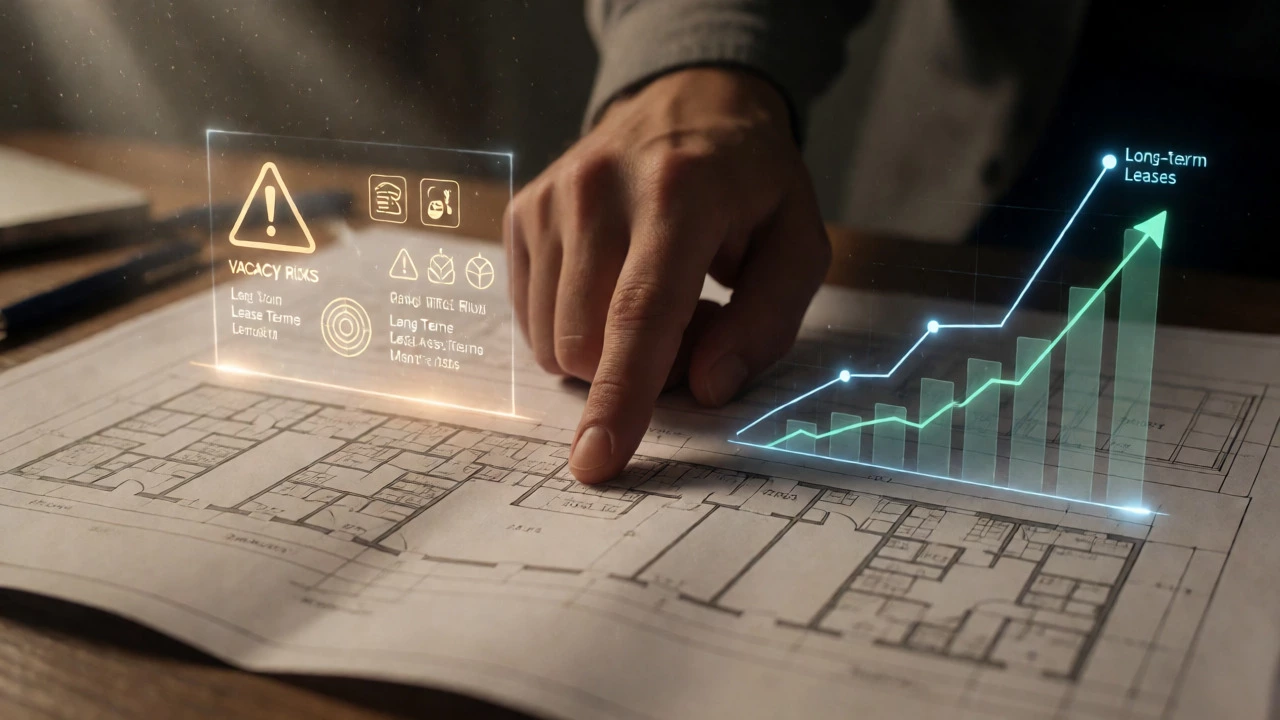
A static cap rate ignores time. Real estate is dynamic. Tenants leave. Rents drop. Expenses rise. A 6.67% cap rate today could become 4% next year if your main tenant vacates and you spend six months searching for a replacement. During that downtime, your NOI drops, but your holding costs remain. This is why experienced buyers don’t just look at the current cap rate; they stress-test it.
Consider the lease structure. Are leases long-term (10+ years) with rent escalations? Or are they short-term (1-3 years)? Long leases provide stability, justifying a lower cap rate. Short leases offer flexibility to raise rents quickly, which might justify a slightly lower cap rate if inflation is high, but usually demand a higher cap rate to compensate for vacancy risk. Always ask: What happens to this NOI if vacancy increases by 5%?
Beyond the Cap Rate: Other Metrics You Need
Don’t rely solely on cap rate. It’s a starting point, not the finish line. Pair it with other metrics to get a full picture of performance.
- Cash-on-Cash Return: This measures annual cash flow divided by actual cash invested. If you put down 20% ($2.4M) and borrow the rest, your cash-on-cash return will differ significantly from the cap rate due to interest payments.
- Debt Service Coverage Ratio (DSCR): Lenders care about this. It’s NOI divided by annual debt service. A DSCR below 1.25 often triggers loan covenant breaches. With an $800k NOI, ensure your mortgage payments stay well below this threshold.
- Total Return: Includes capital appreciation plus cash flow. If the area is gentrifying, a 6.67% cap rate might be excellent if property values rise by 5% annually, bringing total return to over 11%.
Practical Steps for Due Diligence
Before signing the contract for this $12M building, verify the NOI independently. Don’t trust the seller’s spreadsheet blindly. Request three years of historical operating statements. Look for anomalies. Did they waive management fees in Year 2 to boost NOI artificially? Did they exclude necessary repairs?
Engage a professional valuer. They will inspect the property and assess physical condition. A building selling at a high cap rate might need $500k in immediate capital expenditures. Subtracting that from your first-year cash flow drastically changes the economics. Also, review the tenant mix. Concentration risk is real. If one tenant accounts for 60% of the rent, their departure tanks your NOI overnight.
Frequently Asked Questions
What does a high cap rate indicate?
A high cap rate generally indicates higher perceived risk. It suggests the property may have volatile income, poor location, significant physical issues, or short-term leases. Investors demand higher yields to compensate for these uncertainties compared to safer, prime assets with lower cap rates.
Can I use gross income instead of NOI for cap rate?
No, using gross income will give you an inflated and inaccurate cap rate. Gross income ignores operating expenses. Since cap rate measures return after operational costs, you must use Net Operating Income (NOI). Using gross income would result in a cap rate that looks better than reality, potentially leading to overpayment.
How does leverage affect my return if the cap rate is 6.67%?
Leverage amplifies returns. If your borrowing cost is lower than the cap rate (e.g., 5% interest), you gain positive leverage, increasing your cash-on-cash return. If interest rates exceed the cap rate, you experience negative leverage, reducing your equity return. Always compare your cost of debt to the asset's cap rate.
Is cap rate the same as ROI?
Not exactly. Cap rate is a snapshot of current yield assuming an all-cash purchase. ROI (Return on Investment) typically considers total cash outlay, financing costs, tax benefits, and eventual sale proceeds over a holding period. Cap rate is a component of ROI analysis but not the complete picture.
What is a good cap rate for commercial property in Australia?
It varies by sector and location. Prime office assets in major cities often trade at 4.5%-5.5%. Industrial and logistics assets might range from 5.5%-7%. Retail and hospitality can vary widely from 6%-9% depending on tenant quality and location strength. Always compare against recent local sales.